
By Mayfair Properties & Developers. Rents are October 2026 asking figures from published research and our own listings; the legal and tax position is as at October 2026. General tenant guidance, not advice.
Most Mondays the office gets a version of the same call. Someone starts a job in Cyber City, or on Golf Course Extension Road, or at Manesar, in three weeks. They have between Rs 45,000 and Rs 1 lakh a month, a family or the plan for one, and no idea whether that money gets them a good 3 BHK near the office or a long commute. If you are searching for 3 BHK rent in Gurugram (still Gurgaon to most of its tenants), this guide is written for that call.
We have been letting homes in Gurugram since 1999, and this is what working professionals ask us most: what a 3 BHK costs corridor by corridor, what else you pay, how to pick a corridor from where you work, the paperwork in order, and what the tax rules mean for a tenant now that the Income-tax Act 2025 is in force.
Everything here is as at October 2026 and is general information, not advice for your situation. Rents are asking rents, from published research and our own listings, not what a tenant finally agreed. Confirm tax and legal points with a chartered accountant; we let homes, we do not practise tax or law. If you want to skip ahead, our current rent listings are live and kept current by the office.
What a 3 BHK costs, corridor by corridor
Start with the one institutional number. Magicbricks’ Rental Index for January to March 2026 puts the average asking rent for a 3 BHK in Gurugram’s popular localities at Rs 58,400 a month (a 2 BHK at Rs 40,100). The bands in the table are what portals and brokers quote in 2026; the anchors are portal averages, ANAROCK figures and our own listings, labelled as such.
| Corridor | Typical asking band, unfurnished 3 BHK, gated society or good builder floor | Anchors |
|---|---|---|
| Golf Course Road (DLF Phases 1 to 5, Sectors 42, 43, 53, 54) | Rs 65,000 to 1,25,000; DLF 5 condominiums go beyond | DLF Phase 2 average Rs 81,400 (Magicbricks, Jan to Mar 2026) |
| Golf Course Extension Road and SPR (Sectors 58 to 67, 69 to 72) | Rs 50,000 to 95,000 | Sector 61 average Rs 59,700; Sector 65 average Rs 83,600 (Magicbricks). Our 2 BHK in Emaar Digihomes is listed at Rs 75,000, which shows where the top of this corridor sits |
| Sohna Road (Sectors 47 to 50) | Rs 40,000 to 75,000 | Our asking, October 2026: 3 BHK with servant room, Vipul Greens, Rs 62,000; 3 BHK with study and servant room, Vipul Greens, Rs 68,000; furnished 3 BHK builder floor, Uppal Southend, Rs 65,000; 4 BHK with servant room, Omaxe The Nile, Rs 75,000 |
| New Gurugram (Sectors 81 to 95) | Rs 25,000 to 45,000 | Sector 89 average Rs 34,300 (Magicbricks); 2 BHK quoted at Rs 22,000 to 35,000 (ANAROCK, June 2026 quarter) |
| Dwarka Expressway (Sectors 99 to 113) | Rs 32,000 to 60,000 | 2 BHK quoted at Rs 25,500 to 37,000 (ANAROCK, June 2026 quarter); large handovers in 2025 and 2026 have added stock |
Three things to read into that table. The city average of Rs 58,400 is a Sohna Road number: Golf Course Road and the better Golf Course Extension societies sit above it, New Gurugram and most of Dwarka Expressway below. A Rs 65,000 budget buys a well-kept 3 BHK with a servant room on Sohna Road, a smaller or older 3 BHK on Golf Course Extension Road, and a 2 BHK on Golf Course Road.
Furnishing moves the number more than people expect: Magicbricks’ Golf Course Extension Road page shows Rs 85,000 for an unfurnished 3 BHK against Rs 1,19,500 furnished in the same quarter, a premium of about 40 percent.
And these are asking rents. The agreed figure is usually lower in 2026, for reasons the next section explains. For the two corridors most of our tenants choose between, see Sohna Road vs Golf Course Extension Road.
Why 2026 is a tenant's market for 3 BHKs
Facts first, from the Magicbricks Rental Index for January to March 2026:
- Rental supply in Gurugram rose 10.4 percent in the quarter and 16.2 percent on the year. Demand rose 0.9 percent in the quarter and fell 4.6 percent on the year.
- Asking rents fell 1.1 percent in the quarter and 2.5 percent on the year, while the national average rose 14 percent on the year.
- The new supply is where the new buildings are: Southern Peripheral Road listings up 27 percent, Dwarka Expressway up 21 percent, New Gurugram up 13 percent, against 8 percent in the established core.
- The mismatch that matters to you: 3 BHKs are 48 percent of what is listed in Gurugram but 25 percent of what tenants search for. Demand sits in 1 and 2 BHKs.
The April to June quarter looked firmer nationally (rents up 2.2 percent on the quarter, demand up 16 percent), and Magicbricks reported double-digit demand growth in Gurugram, but published no Gurugram rent change for it. The July to September index was not out when this was written. The honest statement is: the early-2026 dip may have stopped, but the oversupply of 3 BHKs has not gone anywhere.
Our view, clearly labelled as opinion: for a 3 BHK tenant this is the best negotiating position in at least two years, especially where several owners in one society are letting at once. Use it on the terms, not only the rent.
- Offer two months’ deposit instead of three.
- Ask for society maintenance to be included in the rent, or at least capped. With maintenance bills rising across Gurugram in 2026 (see below), this is worth more than a small rent cut.
- Ask for 5 percent annual escalation rather than the 10 percent most printed agreements still carry.
- Ask for a lock-in of six months and one month’s notice after it.
- If the flat has been empty for more than a month, say so. The owner knows what an empty month costs.
What else you pay
The rent is the largest line, not the only one. Items marked “practice” are what the Gurugram market generally does, not rules.
- Security deposit. Two to three months’ rent (practice), interest-free, refunded at the end against damage beyond normal wear and unpaid dues. Haryana law sets no cap on the deposit and no deadline for its refund, so both go into the agreement.
- Society maintenance. Charged per square foot per month by the RWA or the maintenance agency. In 2026 the common range in Gurugram condominiums is Rs 3 to 5.50 per sq ft, and it is rising: after Haryana’s minimum-wage revision from April 2026, Emaar Palm Gardens moved from Rs 3.15 to Rs 4.37, a Sector 95 society from Rs 3.04 to Rs 4.13, and one builder-managed society from Rs 3 to Rs 5.33 (Times of India, Hindustan Times, Indian Express, June to August 2026). On a 1,700 sq ft flat that is Rs 5,000 to 9,000 a month, and once the bill crosses Rs 7,500 a month GST at 18 percent applies on it. Who pays is negotiable; ask for the latest bill before you decide.
- Electricity and power backup. Many Gurugram societies are billed by DHBVN in bulk and re-bill each flat at a single per-unit rate that folds in diesel backup and common-area power, so the rate on your bill is higher than the published DHBVN tariff. In a long summer of cuts, backup for three air-conditioners adds up. Ask the owner or the RWA what a June bill looked like.
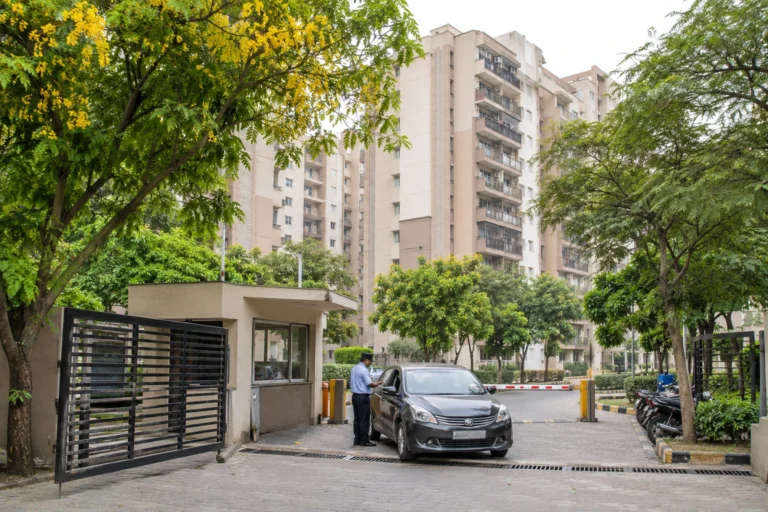
- Club charges and parking. Some societies bill clubhouse access separately. One covered slot usually comes with the flat; a second car means a second charge, and in older Sohna Road societies there may be nothing to allot.
- Society move-in. A tenant registration form, copies of the agreement and IDs, and often a refundable shifting deposit or a one-time charge (practice; ask the RWA for the figure).
- Stamp duty on the agreement. Covered below; about Rs 10,000 to 12,000 on a Rs 65,000 rent if done properly, far less the way most of the market does it.
- Police verification. Rs 50 on the Haryana Police citizen portal. Details below.
- Utilities. Electricity stays in the owner’s name and you pay the bills; piped gas usually carries a connection deposit; internet is yours to arrange.
A word on the owner’s side, because it explains their behaviour. At Gurugram’s prices an owner’s gross rental yield is between roughly 2.5 and 4.3 percent of the flat’s value depending on whose measure you use (ANAROCK puts the city at 4.3 percent for the June 2026 quarter), before property tax, vacant months and repairs. That is why an owner fights harder over the lock-in than over Rs 2,000 of rent, and why a tenant with a clean file, a quick move-in and a full eleven months gets a better deal than one who haggles on the rent alone.
Pick the corridor by your office, not by the brochure
For working professionals the commute decides whether the flat was a good idea. The times below are rough peak-hour, door-to-door guides, not measurements; drive or map your own route at 9 am on a weekday before you sign.
| Where you work | Corridors that make sense for a 3 BHK | Rough peak commute |
|---|---|---|
| Cyber City, Udyog Vihar, DLF Phases 2 and 3, MG Road | Golf Course Road, DLF Phases 1 to 5, Sectors 43 to 56, Sushant Lok | 15 to 30 minutes |
| The same offices, on a Sohna Road or Golf Course Extension budget | Sohna Road Sectors 47 to 50; Golf Course Extension Sectors 61 to 66 | 30 to 45 minutes, longer on bad days |
| Golf Course Extension Road and the Sector 62 to 67 business districts | Golf Course Extension Road, SPR Sectors 69 to 72, Sohna Road | 10 to 25 minutes |
| Sohna Road business parks, Sectors 48 and 49 | Sohna Road, Sectors 50 to 57 | 10 to 25 minutes |
| Manesar, IMT and the Sector 80s industrial belt | New Gurugram Sectors 82 to 95 | 15 to 30 minutes |
| Airport, Aerocity, west and south-west Delhi | Dwarka Expressway sectors; Golf Course Road for the Delhi border | 25 to 45 minutes |
The pattern behind the table: the Rs 20,000 a month saved by living a corridor further out is paid back in an hour a day on the road. In our experience, tenants who took the far corridor to save rent are the ones most likely to ask to move closer at the first renewal.
Furnished, semi-furnished, bare
There is no standard definition in Gurugram, which is how disputes start. What the words usually mean:
- Bare. Fans, lights, geysers, usually a modular kitchen with chimney and hob, often built-in wardrobes. No ACs, no appliances.
- Semi-furnished. The above plus ACs in most rooms, sometimes a refrigerator and washing machine, sometimes a few pieces of furniture. The widest and vaguest category; the photographs on the listing are the only definition that counts.
- Fully furnished. Beds, sofas, dining set, ACs in every room, refrigerator, washing machine, microwave, RO, curtains, often a television. Our Uppal Southend builder floor at Rs 65,000 is this category.
Whichever you take, attach an inventory with photographs to the agreement and write down who pays for servicing and replacement. A furnished premium of 30 to 40 percent makes sense for a stay under two years; beyond that, bare plus your own furniture is usually cheaper.
The paperwork, in order
- Ownership check. Ask for the sale deed or conveyance deed, the latest maintenance bill and the latest electricity bill, and match the name on all three to the person signing. If a relative or a manager signs, ask for the power of attorney. In a builder floor, ask whether the building has its occupation certificate; our guide to builder floors vs apartments explains why.
- The agreement. Almost every Gurugram tenancy is written for eleven months because Section 17 of the Registration Act 1908 requires a lease of twelve months or more to be registered at the sub-registrar’s office, both parties present, within four months of signing. The tenancy itself is governed by the Haryana Urban (Control of Rent and Eviction) Act 1973; Haryana has not adopted the Model Tenancy Act 2021, whatever a downloaded template says.
- Stamp duty. The agreement goes on e-stamp paper (Haryana e-GRAS or SHCIL). The statutory duty on a lease in Haryana is 1.5 percent of the average annual rent for terms up to five years and 3 percent for five to ten. Sources disagree on whether the deposit is added to the base; for an eleven-month term the duty is worked on the rent for the term, so on Rs 65,000 a month that is roughly Rs 10,000 to 12,000. Most eleven-month agreements in Gurugram are still executed on a Rs 100 to 500 e-stamp. That is market practice, not the statutory figure: an under-stamped agreement is not void, but a court can refuse to act on it until the deficit duty and a penalty are paid. Ask your deed writer to compute the correct figure; against eleven months of rent it is small.
- Registration, if the term is twelve months or more. The fee starts at Rs 1,000 and rises on a slab with the rent, capped at Rs 50,000. See our guide to property registration in Gurugram for the office process.
- Clauses to insist on. Lock-in and what happens if either side exits inside it; notice period after it; deposit amount and a refund deadline in days, with deductions itemised in writing; escalation at renewal; who pays maintenance, power backup and club charges; repairs split (small repairs on you, structural and appliance failures on the owner is usual); the inventory; sub-letting, pets and visitors; and a line that the owner will provide what you need for HRA and TDS.
- Police verification. This is the owner’s legal duty, not yours, and it is separate from the agreement. In Gurugram it rests on orders issued by the district magistrate under Section 163 of the Bharatiya Nagarik Suraksha Sanhita; the most recent citywide order, on 12 November 2025, made verification of all tenants mandatory and warned of prosecution for owners who skipped it. Between such orders, the societies enforce it anyway. It is done on the Haryana Police citizen portal (HarSamay or eSaral, or the JanSahayak app) or at the local station; the listed fee for Tenant Verification is Rs 50 with a 21-day timeline under the Right to Service Act. Some guides quote Rs 500; that is the figure cited for offline services at police offices, so apply online. An owner who says “no verification needed” is raising a flag, not doing you a favour.
- Society NOC and gate pass. Most gated societies want the tenant form, agreement copy, IDs and the verification acknowledgement before the gate app lets your movers in. Ask for the list a week before the move.
- Meter readings. Photograph the electricity and gas meters on the day you move in and the day you leave, and send both to the owner on WhatsApp.
Tax for tenants, after the Income-tax Act 2025
Two rules touch almost every 3 BHK tenant in Gurugram. Confirm both with your CA; the Act is new and the forms changed in April 2026.
HRA, and why Gurugram is 40 percent, not 50. If you are in the old regime and receive house rent allowance, the exempt amount is the least of three figures: the HRA received; rent paid minus 10 percent of basic salary (plus dearness allowance where it counts for retirement benefits); and 40 or 50 percent of that salary depending on the city. The 50 percent list grew in April 2026 from four cities to eight (Delhi, Mumbai, Kolkata, Chennai, Bengaluru, Hyderabad, Pune and Ahmedabad) under Rule 279 of the Income-tax Rules 2026. Gurugram is not on it, and neither is Noida.
A tenant living in Gurugram and working in Delhi uses 40 percent; the rule follows where you live. The provision is now Section 11 read with Schedule III of the Income-tax Act 2025, in place of the old Section 10(13A). There is no HRA exemption in the new default regime under Section 202. If you pay rent but receive no HRA, Section 134 (the old 80GG) allows a smaller deduction, capped at Rs 5,000 a month, old regime only.
An illustration, with rounded numbers. Basic salary Rs 1.2 lakh a month, HRA received Rs 6 lakh a year, rent Rs 65,000 a month. The three figures are Rs 6,00,000; Rs 7,80,000 minus Rs 1,44,000, which is Rs 6,36,000; and 40 percent of Rs 14,40,000, which is Rs 5,76,000. The exemption is Rs 5,76,000. Had Gurugram been on the 50 percent list, the full Rs 6 lakh would have been exempt; the difference is about Rs 7,500 of tax a year in the top bracket. Not decisive, but worth knowing when comparing an offer in Gurugram with one in Delhi.
Three housekeeping points. If your annual rent exceeds Rs 1 lakh, your employer will ask for the owner’s PAN, so get it at signing. The new Form 124 (which replaced Form 12BB) also asks you to state your relationship with the owner, so rent paid to a parent or spouse is now declared up front. And the department has been matching HRA claims against owners’ returns and TDS on rent since 2024, so the rent you claim must be the rent you paid, to the owner, through a bank.
TDS on rent above Rs 50,000 a month. This applies in either regime. An individual paying more than Rs 50,000 a month in rent must deduct 2 percent tax at source. Under the 2025 Act this sits in Section 393(1), Table Serial Number 2(i), the successor to the old Section 194-IB. The mechanics: deduct once a year, from the last month’s rent in the financial year or the last month of the tenancy, whichever comes first; deposit it with Form 141 (which replaced Form 26QC) within 30 days from the end of that month, using your PAN and the owner’s; no TAN is needed; then download Form 132 (which replaced Form 16C) and hand it to the owner.
On Rs 65,000 a month that is Rs 15,600 a year, so the March payment to the owner is Rs 49,400. Raise it before signing rather than in March; some owners still do not expect it. If the owner is a non-resident the rules are harsher: deduction from the first rupee at 30 percent plus cess under the non-resident provisions of Section 393, every month, and you need a TAN. Ask the owner’s residential status before you sign.
Society life for a tenant
- Many RWAs have rules on bachelors, sharing, pets and overnight visitors. Ask for the bye-laws before paying the deposit; a society that will not share them is telling you something.
- Water: the tail-end sectors on the GMDA network, broadly Sectors 58 to 80 along Golf Course Extension Road and SPR and parts of New Gurugram, leaned on private tankers in summer 2026. GMDA’s Sector 72 boosting station began trial distribution on 30 September 2026 and should help next summer, but ask the RWA what last May cost in tanker charges.
- Parking is allotted to the flat, not the tenant, and your name goes on the gate app only after the move-in file is complete.
Red flags and the mistakes we see
- The person signing is not on the sale deed and has no power of attorney.
- A builder floor with no occupation certificate, or an owner who cannot say whether there is one.
- Deposit demanded in cash, or rent to be paid into an account that is not the owner’s.
- “No police verification needed.”
- A lock-in equal to the full term with no exit clause, a deposit above three months, or a refund clause that says “within a reasonable time”.
- Signing on the strength of a commute measured on a Sunday.
- Agreeing a furnished rent without an inventory, then arguing about a broken AC at exit.
- Not raising TDS at signing, then deducting Rs 15,000 from the March rent of an owner who was not expecting it.
- Claiming HRA at 50 percent because the office is in Delhi.
- Taking a twelve-month agreement to “feel secure”, then not registering it, which leaves you with a document a court will not read.
Questions we get asked
What is the average 3 BHK rent in Gurugram in 2026?
Magicbricks’ index puts the asking average at Rs 58,400 a month for January to March 2026. Sohna Road sits around that figure; Golf Course Road and the better Golf Course Extension societies are above it, New Gurugram and most of Dwarka Expressway below.
Is Gurugram a metro city for HRA?
No. Even after the 50 percent list grew to eight cities in April 2026, Gurugram and Noida are at 40 percent. The rule follows where you live, not where you work.
Do I have to deduct TDS on my rent?
If you pay more than Rs 50,000 a month to a resident owner, yes: 2 percent, once a year, deposited with Form 141 within 30 days of the end of the month of deduction. Most 3 BHKs on Golf Course Road and Golf Course Extension Road cross the line; many on Sohna Road and New Gurugram do not.
Why are agreements for eleven months?
Because a lease of twelve months or more must be registered, which means both parties at the sub-registrar’s office and a registration fee. Eleven months avoids that. The agreement still has to be stamped.
Can I negotiate the rent in 2026?
Yes, more than in 2024 or 2025. Supply of 3 BHKs is running well ahead of demand, especially on SPR, Dwarka Expressway and in New Gurugram. Negotiate the terms as well as the rent: deposit, maintenance, escalation and lock-in.
3 BHK rent in Gurugram: the short version
- Asking average Rs 58,400 a month in early 2026. Sohna Road Rs 40,000 to 75,000; Golf Course Extension and SPR Rs 50,000 to 95,000; Golf Course Road Rs 65,000 to 1,25,000; New Gurugram Rs 25,000 to 45,000; Dwarka Expressway Rs 32,000 to 60,000. All asking, all negotiable in 2026.
- Supply up 16 percent on the year, rents down 2.5 percent, and 3 BHKs are half of all listings but a quarter of demand. Use that on the terms.
- Budget for two to three months’ deposit, maintenance that is rising in 2026, power backup and a properly stamped eleven-month agreement. Police verification is the owner’s duty, costs Rs 50 online and is not optional.
- HRA in Gurugram is calculated at 40 percent of basic, old regime only. Rent above Rs 50,000 a month means you deduct 2 percent TDS and file Form 141.
- For working professionals the rule of thumb is simple: a smaller flat in the corridor where your office is beats a bigger one an hour away.
Tell us where you work, your budget and the date you need to move in, and we will tell you plainly what exists in that band on Sohna Road, Golf Course Extension Road, Golf Course Road, New Gurugram or Dwarka Expressway, and what we would offer on the terms. See our current rent listings or write to us.
This article is general information as at October 2026 and not legal, tax or investment advice. Rents are asking figures from published research and our own listings, not agreed values. Please seek professional advice before you sign.