
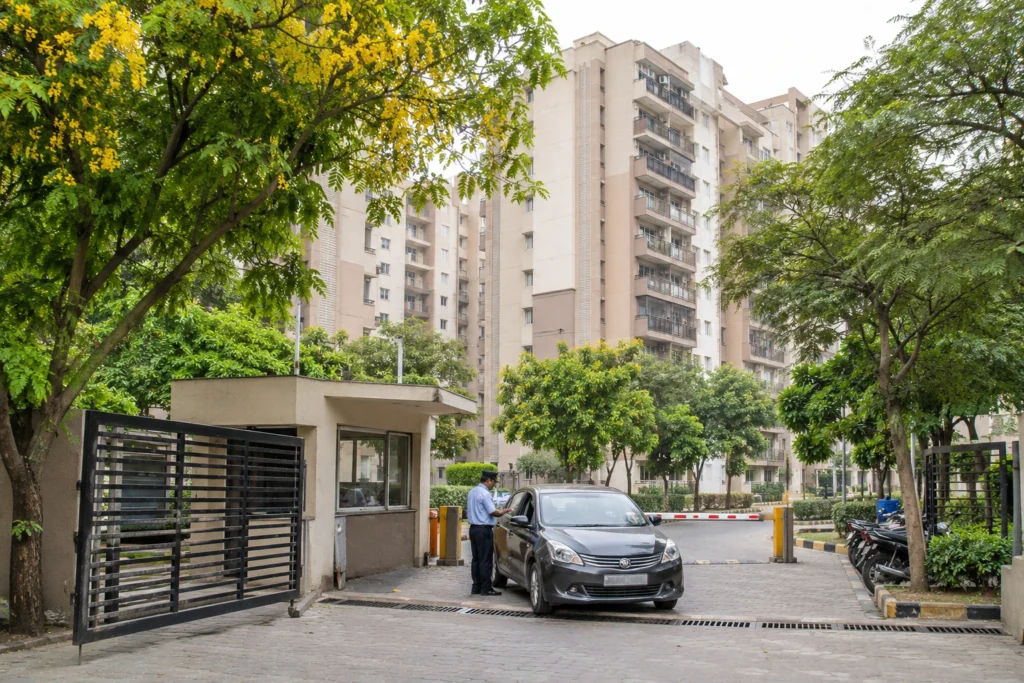
Most of the homes we show on Sohna Road and Golf Course Extension Road sit inside a gated society in Gurugram. Buyers and tenants usually ask us about the price, the floor and the view. Very few ask about the maintenance bill, who actually runs the gate, or what happens to the basement when it rains. Those are the things that decide whether you enjoy the place two years later.
This guide is the conversation we have with clients before they sign anything. It is written for Gurugram in 2026, with real numbers from societies we deal in and from news reports this year. No rankings, no “top 10” list. Just what to check, why it matters, and what a fair answer looks like.
The short version
- A gated society in Gurugram is usually group housing: towers or builder floors inside one boundary wall, with shared security, lifts, parks and a club. Plotted townships are gated too, but the rules and bills work differently.
- Maintenance (called CAM) is charged per square foot of super area every month. In 2026 most mid-range societies on Sohna Road and Golf Course Extension Road fall roughly between Rs 3 and Rs 5.5 per sq ft. Premium towers charge more.
- Bills went up across the city this year after Haryana raised minimum wages by about 35 per cent from 1 April 2026. Several societies moved from around Rs 3 to between Rs 4 and 5.3 per sq ft.
- If your monthly maintenance crosses Rs 7,500, 18 per cent GST applies on the whole amount, not just the excess.
- Ask who runs the society: the builder’s agency or the owners’ association. Ask for the last two years of charges and the latest audited accounts.
- Check water source and timings, power backup per flat, drainage during monsoon, lift condition and the age of the towers.
- Society rules on tenants, pets and guests exist everywhere. Reasonable rules are fine. Blanket bans are usually not enforceable, but a dispute is still a headache you do not want.
What "gated society" actually means here
The phrase covers three quite different things in Gurugram, and the differences matter for your monthly bill.
Group housing societies. Towers of apartments (Vipul Greens, Omaxe The Nile, Emaar Digi Homes) or low-rise independent floors inside a common boundary (Ansal Versalia, the floors at Emaar Emerald Hills, parts of Uppal Southend). One gate, one security team, shared lifts, parks, club and parking. Maintenance is per sq ft and covers all of this.
Plotted townships. Large layouts of individual plots and villas (Uniworld Resorts in Sector 33 is one). The gate and roads are shared, but your house is your own. Charges are usually per sq yard of plot, and the per-unit number is smaller because you maintain your own building. Those rates move too: a Sector 108 plotted township saw its charge go from Rs 10 to Rs 19 per sq yard in two years (Business Standard, October 2026).
Builder floor colonies. Independent floors on individual plots in a licensed colony. Some have a gate at the colony entrance, many do not. There is often no formal maintenance body at all, which means lower cost and also nobody to call when the street light fails.
Most of what follows is about the first type, because that is where most buyers and tenants in our area end up. If you are weighing a floor against an apartment, our builder floor vs apartment guide covers that choice in detail.
Maintenance charges in a gated society in Gurugram: how to read the bill
This is the question we get wrong answers to most often, usually from listing portals that show an old rate.
How it is calculated. Almost every society charges Common Area Maintenance (CAM) per square foot of super built-up area, per month. A 1,860 sq ft 3 BHK at Rs 4 per sq ft pays Rs 7,440 a month. The same flat at Rs 4.5 pays Rs 8,370. A few societies charge a flat amount per unit instead, but that is rare in towers.
What the 2026 numbers look like. Reported rates this year, all from news coverage of specific societies:
| Society (sector) | Earlier CAM | Revised CAM (2026) | Source |
|---|---|---|---|
| Emaar Palm Gardens (Sector 83) | Rs 3.15 / sq ft | Rs 4.37 / sq ft | Times of India, 1 Jun 2026 |
| Gurgaon One (Sector 84) | about Rs 4 / sq ft | about Rs 5 / sq ft | Times of India, 1 Jun 2026 |
| BPTP Astaire Gardens (Sector 70A) | Rs 2.95 / sq ft | over Rs 4.35 / sq ft (18 months) | Times of India, 1 Jun 2026 |
| An affordable housing society (Sector 95) | Rs 3.04 / sq ft | Rs 4.13 / sq ft | Times Now, 3 Aug 2026 |
| Adani M2K Oyster Grande, B1 block (Sector 102) | Rs 3 / sq ft | Rs 5.33 / sq ft | Indian Express, 11 Aug 2026 |
Closer to home, owner reviews for Vipul Greens on Sohna Road mention around Rs 3 per sq ft, while rental listings there quote Rs 7,500 to 9,800 a month for 3 BHK units. Tenants at Omaxe The Nile report roughly Rs 6,000 to 7,000 a month on a 2,082 sq ft flat. Treat all of these as indicative; the only number that counts is the one on the current bill, which the seller or landlord can show you in a minute.
Why bills jumped this year. Haryana revised minimum wages by about 35 per cent with effect from 1 April 2026. Security guards, housekeeping and facility staff are the biggest line in any society budget, so associations across Gurugram estimated a 15 to 30 per cent rise in expenses and passed it on. Some did it retrospectively, which is why residents in a few societies received arrears demands in July and August.
The GST line. Under the tax department’s circular, if your monthly maintenance is more than Rs 7,500 per flat and the association collects more than Rs 20 lakh a year, 18 per cent GST applies on the entire amount, not just the excess. A Madras High Court judge read the rule the other way in 2021, but that order was stayed on appeal, so societies bill on the whole amount. At Rs 7,440 you pay nothing extra. At Rs 8,370 the bill becomes Rs 9,877. Owners’ federations have asked the finance ministry to raise the threshold to Rs 15,000, but as of October 2026 that is only a request.
What else sits on the bill. Common-area electricity (one society reported Rs 0.30 per sq ft on top of CAM), DG power backup charged per unit consumed, water if metered, club membership in some projects, and sometimes a sinking fund contribution for big repairs. Ask for one full bill, not just “the rate”.
Who actually runs the place
Every society starts life maintained by the builder, usually through a facility management agency. At some point it is supposed to pass to the owners’ association, with the Interest-Free Maintenance Security (IFMS) that buyers paid at possession, the accounts, and the drawings.
In practice this handover is where a lot of Gurugram societies get stuck. Vipul Greens residents spent years in disputes with the developer over the IFMS corpus before about Rs 8 crore was finally transferred to the RWA in August 2021. In another society this year, residents told Hindustan Times in August 2026 that a handover due in July 2025 had still not been completed because the full IFMS had not been transferred. Meanwhile, residents in several builder-run complexes protested CAM hikes this summer and demanded audited accounts.
None of this means builder-run is bad and owner-run is good. Builder agencies are often more professional; owner associations are usually cheaper and more accountable. It means you should know which one you are buying into, and ask three things:
- Who issues the maintenance bill today, and since when?
- Can I see the last two years of rate revisions and the latest audited accounts?
- Are there any pending dues on this flat? (In practice dues follow the flat: societies withhold the no-dues certificate until arrears are cleared, and the buyer ends up paying. Get that certificate before registration.)
One more thing worth knowing. In June 2026 the Haryana Registrar General of Societies ruled that associations cannot cut essential services such as garbage collection or digital access to recover dues, and that charges must be proportional to apartment size. Associations still have every right to recover what is owed through legal means. The point is that disputes get resolved on paper, not at the gate.
Two different bodies can exist in the same society: a Resident Welfare Association registered as a society, and an Apartment Owners’ Association tied to ownership of the flat. Owners sometimes struggle to get voting membership in the first. If having a say matters to you, ask which body makes decisions and how an owner joins.
Security: what to look at beyond the guard count
The gate is the whole reason people pay for a gated society, so test it rather than take it on trust.
- Boom barriers and RFID stickers for resident cars, or a guard waving everyone through? Vipul Greens, for example, moved to RFID gates some years ago. Older reviews of Omaxe The Nile mention manual gates; check whether that has changed.
- Visitor management. Is there an app or intercom confirmation before a delivery person is let in, or a paper register?
- CCTV coverage at the gate, in lift lobbies and basements. Ask who monitors it and how long footage is kept.
- Night staffing. Visit after 9 pm once. The 3 pm guard count and the 11 pm guard count are often different numbers.
- Basement lighting and lift access from the parking level. Tenants, especially people living alone, notice this within a week.
Water, power backup and drainage
Gurugram’s weakest infrastructure is below ground, and a boundary wall does not fix it.
Water. Sectors 62 to 70 along Golf Course Extension Road sit at the tail end of GMDA’s supply network. The authority announced a new pipeline for these sectors in June 2026, and its Sector 72 boosting station finally began distribution trials on 30 September 2026 (Hindustan Times, 3 October 2026), which should help Sectors 58 to 80 over the coming months. Even so, a damaged master pipeline near Sector 62 on 22 October 2026 cut supply to 17 sectors. Ask how many hours of GMDA supply the society gets, whether it has its own borewells, how often tankers are needed in May and June, and whether the water charge is fixed or metered.
Power. Ask the backup capacity per flat (5 kVA, 8 kVA, 10 kVA) and the DG rate per unit. During the power staff strike of 21 to 23 October 2026, parts of the city went without supply for 16 hours or more; a society with undersized generators becomes very uncomfortable very quickly.
Drainage. Before this monsoon the traffic police listed 57 waterlogging points across the city, six of them on Southern Peripheral Road and two on Golf Course Extension Road, and GMDA worked on 42 vulnerable sites of its own, 17 of them on SPR. Inside societies, the usual failure points are basement parking and sewage lines backing up during heavy rain. Resident reviews for Vipul Greens mention sewage problems in heavy rain. Ask the guard, not the broker, what happened in the last big downpour. Then look at the basement walls for tide marks.
The building itself
Age and structure. Towers on Sohna Road were largely handed over between 2007 and 2013. Golf Course Extension Road is newer, with some projects handed over as recently as 2023 and 2024. Age is not a problem in itself; neglected age is. In July 2026 the town planning department ordered a developer in Sector 37D to carry out a structural audit and repair every balcony after residents complained. Ask whether your society has ever had a structural audit and what came of it.
Seepage and finish. Even new towers get complaints. Reviews of a recently delivered Golf Course Extension Road project mention seepage and plaster issues in the first year. Look at the ceiling under bathrooms, the wall behind the kitchen sink, and the balcony slab edge.
Lifts and fire systems. How many lifts per tower, how many are working today, and when were they last serviced? Is the fire NOC current? These are quick questions with quick answers if the society is well run, and awkward silences if it is not.
Society rules: what is normal and what is not
Every society has a rule book. Most of it is sensible: leash pets in common areas, register tenants and domestic help with security, no commercial use of flats, quiet hours after 10 pm, allotted parking only.
Problems start when rules go beyond management of common areas. Lawyers quoted by Times of India in August 2026 put it simply: an association can ask for tenant details and act against genuine nuisance, but it cannot ordinarily impose a blanket ban on bachelors, students or a particular community, and a flat ban on pets or a special pet charge would need a clear legal basis. In 2017 an MG Road society had to withdraw rules that barred single tenants from having guests of the opposite sex after police-mediated talks, and a civil court stayed its entry restrictions.
Our practical advice is less legal and more human. If you are a landlord, find out the society’s attitude to tenants before you buy to let; some societies are quietly hostile and your flat will sit empty longer. If you are a tenant with a pet or an irregular work schedule, ask to read the rules before you pay the deposit. Being technically right in a dispute with your own neighbours is a poor way to live.
Pros and cons, honestly
| Gated society | Builder floor colony or standalone building | |
|---|---|---|
| Security | Controlled entry, CCTV, staffed 24 hours | Depends entirely on the colony; often none |
| Monthly cost | CAM Rs 5,600 to 10,200 on a 1,860 sq ft 3 BHK; Rs 8,000 to 13,000 once DG, water and club are added; GST above Rs 7,500 | Often under Rs 2,000 in older colonies, nothing in some; newer gated floor projects charge more |
| Amenities | Pool, gym, club, parks, children’s play areas | Rarely |
| Power and water backup | Society-level DG and tanks | Your own inverter and overhead tank |
| Rental demand | Strong, especially from families and corporate tenants | Narrower pool; price-sensitive tenants |
| Control | Decisions by association or builder; rules apply to you | You decide almost everything |
| Resale | Easier to value, more buyers | More variable; depends on plot and builder |
| Risk | Maintenance disputes, handover delays, rule fights | Structural quality varies; no shared fund for repairs |
If you want the trade-off in one line: a gated society in Gurugram buys you predictability and services, and you pay for both every month whether you use them or not.
What a 3 BHK really costs per month to hold
A rough monthly outgoing sheet for a 1,860 sq ft 3 BHK in a mid-range Sohna Road society, excluding EMI or rent:
| Item | Typical 2026 figure | Notes |
|---|---|---|
| CAM at Rs 4 per sq ft | Rs 7,440 | Below GST threshold |
| CAM at Rs 4.5 per sq ft | Rs 8,370 plus Rs 1,507 GST = Rs 9,877 | Crosses the threshold |
| DG backup | Rs 500 to 2,500 | Depends on outages and usage |
| Water | Often inside CAM; Rs 300 to 1,000 if metered | Ask |
| Club or second car parking | Rs 0 to 2,000 | Project specific |
| Property tax (owners) | Varies by size and sector; usually small next to CAM | MCG self-assessment, paid yearly |
So the honest range is Rs 8,000 to 13,000 a month for a typical 3 BHK in most cases, and past Rs 15,000 once CAM crosses the GST line and DG use is heavy, all before you switch on a light inside the flat. Budget for it. If you are renting, confirm in writing who pays CAM; in Gurugram the owner usually does, but “usually” is not a lease clause.
The 10 questions to ask before you sign
- What is the current CAM rate per sq ft, and what was it two years ago?
- Show me one complete recent maintenance bill for this flat.
- Who runs maintenance today, builder’s agency or owners’ association, and has the IFMS been handed over?
- Are there pending dues on this unit? Get a no-dues certificate.
- How many hours of municipal water, and how many tanker days last summer?
- Power backup capacity per flat and the DG rate per unit?
- What happened in the basement during the heaviest rain this year?
- How many lifts per tower, and when were they last inspected?
- Has the society had a structural audit? Any ongoing repair levy or sinking fund demand?
- What are the rules on tenants, pets, guests and parking, in writing?
A seller or landlord who answers these in ten minutes is probably offering a well-run society. One who gets irritated is telling you something too.
Buying versus renting in a gated society
If you are renting, the society’s problems are mostly the owner’s problems, but the daily experience is yours. Prioritise security, water, lifts and the tenant rules. Our 3 BHK rent guide covers rents and deposits across the main corridors.
If you are buying, you are also buying a share of the society’s future repairs and its governance. Prioritise the handover status, the accounts, the structural condition and the trend in CAM. A beautifully kept lobby funded by a builder who is about to hand over a depleted IFMS is not the bargain it looks like. For current prices by corridor, see our Gurugram property prices 2026 article, and for a detailed look at three Sohna Road and Golf Course Extension Road societies, our Vipul Greens review compares them side by side.
How we can help
Mayfair Properties & Developers has worked on Sohna Road and Golf Course Extension Road since 1999. We know which societies have settled their handover, which ones have borewells, and which basements flood. When you shortlist a flat with us, we get the current maintenance bill and the no-dues position from the seller before you visit, not after you fall in love with the balcony.
Browse our current listings for sale and rent, or message us on WhatsApp with the society name and we will tell you what we know, including the parts that are not in the brochure.
Frequently asked questions
What is the average maintenance charge in a gated society in Gurugram in 2026?
For mid-range group housing on Sohna Road and Golf Course Extension Road, reported rates in 2026 fall roughly between Rs 3 and Rs 5.5 per sq ft of super area per month, with premium towers higher. On a 1,860 sq ft 3 BHK that is about Rs 5,600 to 10,200 a month before GST. Rates rose across the city after the April 2026 minimum wage revision, so check the current bill rather than relying on an older figure.
Is GST charged on society maintenance?
Yes, 18 per cent on the whole amount, if the monthly maintenance is above Rs 7,500 per flat and the society's annual collections exceed Rs 20 lakh. Below that threshold, no GST. Confirm the current rule with the society or a tax professional, as owners' bodies have asked for the threshold to be raised.
Can the builder or RWA increase maintenance charges whenever they want?
Charges are meant to recover actual costs and should be supported by accounts. In practice revisions happen, often after wage or energy cost changes. Ask for the basis of any increase and the audited accounts. If you believe a hike is unjustified, the remedy is through the registrar or the courts, and you should seek professional advice.
Can a society ban bachelors or pets?
Reasonable rules on tenant verification, leashing and use of common areas are normal. Blanket bans based on marital status, profession or community, or outright pet bans, are generally not considered enforceable, according to lawyers quoted in August 2026. That said, a society's attitude matters in daily life, so read the rules and talk to residents before committing.
Does the tenant or the owner pay maintenance in Gurugram?
Most commonly the owner pays CAM and the tenant pays for electricity, DG units and any club usage, but there is no fixed rule. It must be written into the lease.
Is an older society on Sohna Road a worse choice than a new one on Golf Course Extension Road?
Not automatically. Older societies tend to have settled handovers, mature greenery and established owner associations, but may have ageing lifts and plumbing. Newer societies have fresher buildings and often better parking and security systems, but sometimes unfinished handovers and first-year defects. The checklist above applies to both.
Sources
- Times of India, 1 June 2026: Condo upkeep bills set to go up with labour code’s higher wages mandate (Emaar Palm Gardens, Gurgaon One, BPTP Astaire Gardens figures).
- Indian Express, 11 August 2026: From Rs 7,900 to Rs 13,500, why maintenance fees at Gurgaon condos are increasing.
- Times Now, 3 August 2026: Sector 95 residents protest maintenance fee hike.
- Business Standard, 5 October 2026: Maintenance fee rises 90 per cent in Gurugram township.
- Hindustan Times, 2 July 2026: RWAs cannot make homes uninhabitable to recover maintenance dues (Haryana Registrar General order of 16 June 2026).
- Hindustan Times, 2 August 2026: Gurugram apartment owners seek dedicated registrar, GST threshold request.
- Hindustan Times, 4 August 2026: Balcony plaster collapse, handover and IFMS pending.
- Times of India, 20 August 2026: What your RWA can legally ban, and what it can’t.
- The Print, 18 August 2026: Gurugram residents fighting for RWA membership.
- Hindustan Times, 9 June 2026 (GMDA pipeline, Sectors 62 to 70), 23 June 2026 (traffic police list of 57 waterlogging points), 12 July 2026 (GMDA’s 42 vulnerable sites), 3 October 2026 (Sector 72 boosting station), 24 October 2026 (Sector 62 master pipeline damage).
- India Today, 14 August 2017 and Times of India, 21 August 2017: Essel Towers guest rules withdrawn; civil court stay.
- Times of India, 5 August 2021: Vipul Greens IFMS transferred to RWA.
- Owner and tenant reviews on 99acres, Magicbricks and NoBroker for Vipul Greens and Omaxe The Nile (maintenance figures, gates, drainage), read October 2026.
Figures are indicative and change. Maintenance rates, GST treatment and society rules differ by project and over time. This article is general information, not legal or financial advice. Please verify current charges with the society and seek professional advice before making a decision.