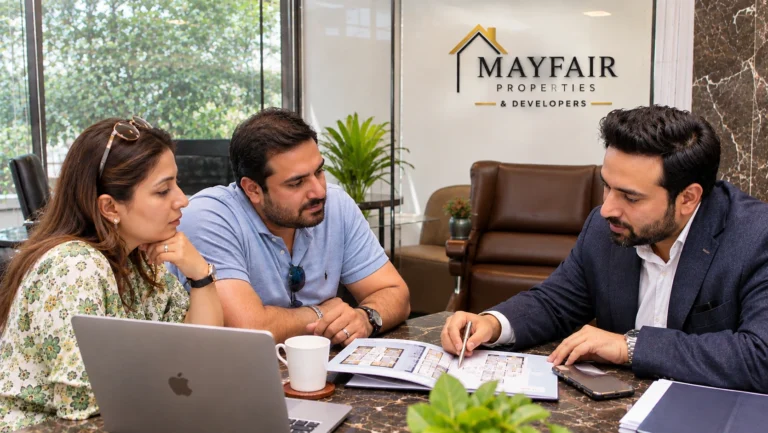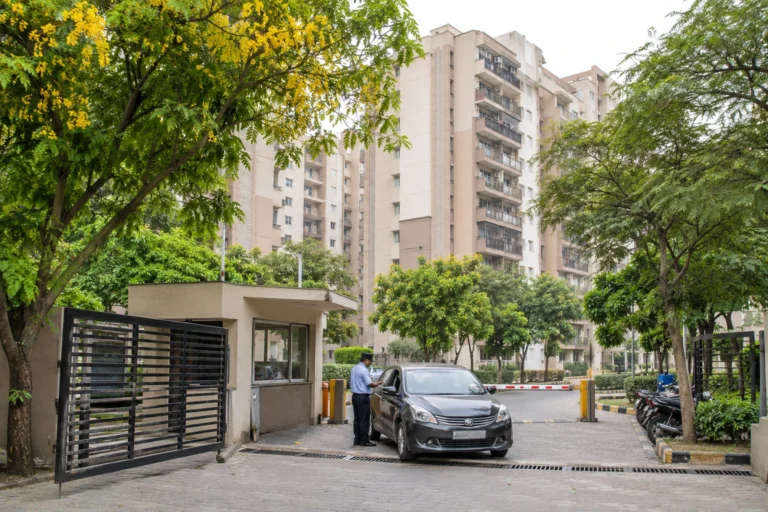
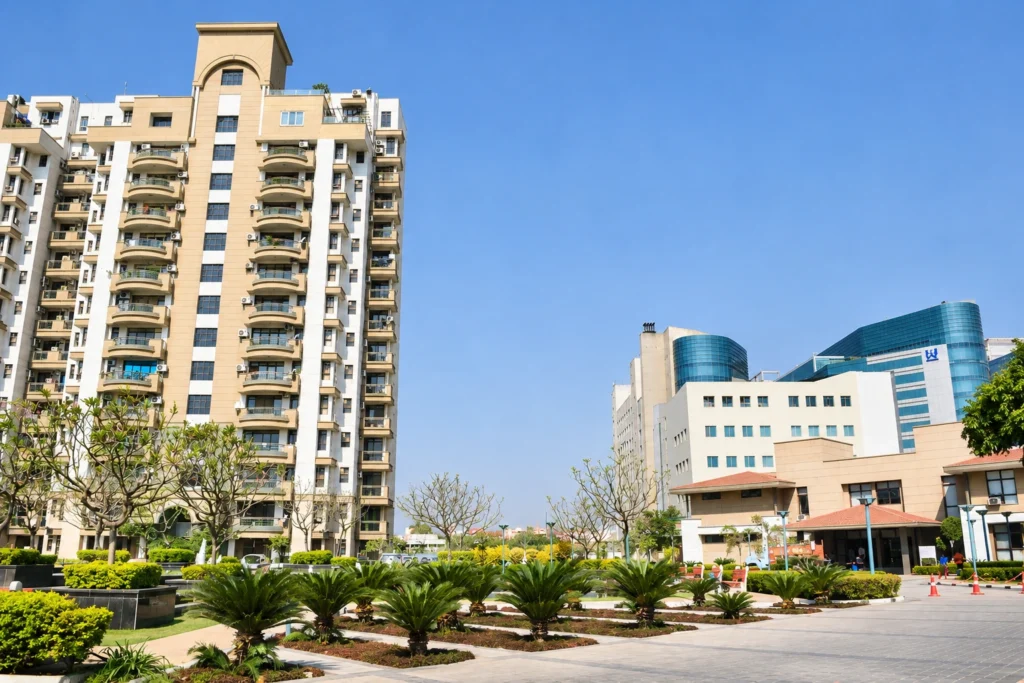
An illustration, not a real client: an owner on Sohna Road called us in March after eleven months on the portals. He had priced his 3 BHK at what a neighbour said a higher floor had gone for; the neighbour’s number turned out to be an asking price, and every serious buyer had walked after the first visit. By the time we met, the listing was stale, the society had new arrears against the flat, and the buyers’ lawyers had started asking questions he could not answer from memory.
That is the usual shape of a slow sale, and very little of it is about the market. This note on how to sell a flat in Gurugram sets out what we do in the pre-listing meeting at our Sector 48 office: how a price range is built from registered transactions, the papers a buyer’s bank and lawyer will ask for, who should sell it, what happens between the first offer and registry day, the tax the seller pays, and how long each step really takes. It is the long-form companion to our sell property page. The tax and registration rules are national and Haryana’s; our work is Gurugram only.
The short version
- Price from registered transactions in your society, not from asking prices or a neighbour’s story. We quote a range, with the date of the data behind it.
- Five papers delay most sales: the society no-dues, the municipal property tax no-dues, the bank’s original documents after loan closure, the occupation certificate of the tower, and a complete chain of title. Start them before the listing goes up.
- The sequence is offer, token, agreement to sell, buyer’s loan, registry. Each step has a clock, and the buyer’s bank sets most of them.
- Registration in Haryana has been paperless since 1 November 2025: the deed is drafted on the state’s e-registration portal from its templates, the documents are uploaded and checked in advance, and one visit to the sub-registrar covers biometrics and signing.
- Long-term capital gains on a flat held for more than 24 months are taxed at 12.5 per cent under Section 197 of the Income-tax Act, 2025 (the old Section 112). The reinvestment and bond routes still exist, with new section numbers.
- The buyer deducts 1 per cent TDS on a price of Rs 50 lakh or more. If you are an NRI seller it is far more, and you need a certificate before the agreement.
How to sell a flat in Gurugram at the right
price: building the range
When owners ask us how to sell a flat in Gurugram at the right price, the first hour of the meeting is about one question: what has actually been paid for flats like yours. Not what is listed, not what a neighbour says a buyer offered, but registered transactions in your society and the two or three it competes with, over the last six to nine months. Portals show asking prices, and in a market where listings sit for months, asking prices run well above what closes.
On top of that base we adjust for the things buyers in Gurugram pay for: floor and view, a corner or park-facing unit, the condition of the kitchen and bathrooms, covered parking, whether the flat is vacant or tenanted, and the society’s own standing, meaning its maintenance arrears, its lifts and its handover status (our gated society note lists what buyers check). A tenanted flat sells to an investor at one number and to a family at a lower one, because the family has to wait.
Why a range and not a number. A single figure is a negotiating position, not a valuation, and the honest reading of late 2026 is that Gurugram prices have stopped sprinting. Knight Frank’s count for January to September 2026 has Gurugram prices up about 4 per cent year on year, with sales across the National Capital Region down about 11 per cent and Gurugram holding the largest share of the region’s unsold stock. Square Yards data to September 2026 puts Golf Course Extension Road at roughly Rs 19,100 to 19,300 per sq ft, almost flat on the year.
A buyer in that market has time, so your range needs a realistic floor and a defensible top, with the top justified by something specific about your flat. Our prices note has the corridor-wise detail.
What the circle rate does and does not tell you. The collector rate was revised on 1 April 2026; group housing in Sectors 47 to 50 under the Badshahpur sub-tehsil moved to Rs 10,000 per sq ft from Rs 9,100 (a few named societies on Sohna Road sit at Rs 11,000). That is the minimum value the deed can be registered at, and it sets the stamp duty floor. It is not a market price. In the societies we sell in, registered prices run well above it, so it matters for the buyer’s cost sheet, not for your asking range.
The papers a buyer's lawyer will ask for
Most of the delayed sales we see are paperwork, and the paperwork is almost always something the seller could have started a month earlier. Much of how to sell a flat in Gurugram without losing the first buyer is in the table below. Gather it before the first viewing: a buyer taking a loan will need all of it for the bank’s legal check, and a cash buyer’s lawyer will ask for the same set.
| Paper | Who issues it | Typical time to get |
|---|---|---|
| Sale deed or conveyance deed in your name, plus the earlier deeds in the chain | Sub-registrar; certified copies if an original is lost | In hand, or 1 to 2 weeks for certified copies |
| Builder-buyer agreement, allotment letter, possession letter | Your file; the developer for duplicates | In hand, or 2 to 4 weeks from the developer |
| Occupation certificate of the tower | Town and Country Planning department; the developer or RWA holds a copy | Same day from the RWA if they have it; weeks if they do not |
| Society no-dues certificate and transfer NOC | RWA or apartment owners’ association | 1 to 3 weeks after dues are cleared |
| Municipal property tax no-dues certificate | Municipal Corporation of Gurugram, through the ULB Haryana portal | Immediate online once the Property ID is correct and dues are paid |
| Electricity no-dues, with the meter in your name | DHBVN | A few days |
| Loan closure letter, release of charge and the original documents | Your bank | Up to 30 days after the final payment, by RBI rule |
| Encumbrance and title search | Buyer’s lawyer, from the sub-registrar’s records | 1 to 2 weeks |
| PAN and Aadhaar of every owner; for an NRI seller, passport, OCI and a lower-deduction certificate | Owner; the assessing officer for the certificate | Certificate 4 to 8 weeks |
Three of these deserve a word. The occupation certificate belongs to the tower, not to you, but a bank will not lend against a flat in a tower without one, so find out early whether yours has it. The municipal no-dues needs an active Property ID on the ULB Haryana portal with the owner’s name and area correct; fixing a wrong entry takes longer than paying the tax.
And if the flat has ever been on a loan, the bank must release the original deeds and remove its charge within 30 days of full repayment, with compensation of Rs 5,000 a day for delay beyond that, under the Reserve Bank’s direction of September 2023, in force for loans closed since December 2023. Buyers’ lawyers now check the central registry of charges (CERSAI) for a lingering charge, so collect the release letter and the originals, not just the no-objection certificate.
Preparing the flat: what moves the price and
what does not
Six things that move the price in Gurugram resale, in our experience: a clean, working kitchen and bathrooms with no seepage marks; fresh paint in neutral colours; every light, tap and geyser working on the day of the viewing; clear balconies and a tidy entrance; the parking slot visibly yours and free of someone else’s car; and a folder with the papers above ready to hand over. Buyers in the Rs 1.5 to 4 crore bracket are paying for the absence of worry as much as for the square feet.
Four things that do not: a modular kitchen installed for the sale, which buyers replace; false ceilings and wallpaper; furniture, which they do not want; and a higher asking price to leave room for negotiation, which simply removes you from the buyer’s shortlist on a portal filter.
What we show and what we tell. We photograph the flat in daylight after the cleaning, not before, and we tell buyers about the society’s pending issues ourselves, whether that is a lift under repair or a parking dispute. A buyer who learns it from the guard after paying a token walks away, and the flat goes back on the market with a story attached.
Who should sell it: one broker, many brokers
or the portals
The second question in every conversation about how to sell a flat in Gurugram is who should sell it. There are three routes, and each has a cost that is not the fee.
Exclusive mandate with one broker. One point of contact, one price in the market, one set of keys. The broker invests in photographs, a floor plan and buyer follow-up because the sale is theirs to lose. The risk is picking the wrong broker, so the mandate should be short, 60 to 90 days, with a written exit.
Open brokering. Five brokers, five asking prices, the same buyers shown the flat twice by different people, and a society guard tired of visitors. It feels like more coverage; in practice buyers read a flat listed at four prices as a distressed one. It works for a plain, mid-priced flat in a large society where volume matters more than positioning.
Portals, on your own. Cheapest, and fine for a seller with time who does not mind the calls. The costs are the broker enquiries pretending to be buyers, the viewings that do not turn up, and the absence of anyone to run the paperwork once a buyer says yes, which is where most deals stall.
How brokers are paid is a conversation we have in person, with the figure in writing before any mandate; nothing on this page is a fee schedule. Ask us which route fits your flat and we will tell you, including when the answer is the portal.
From offer to registry: the sequence and the clocks
- Offer and acceptance. In writing, even on WhatsApp, with the price, the inclusions, the possession date and who pays what. Verbal offers in Gurugram evaporate by the weekend.
- Token. A small payment, typically 1 to 2 per cent, against a receipt that says what happens if either side withdraws. Keep it small and the terms specific; large tokens with vague terms create disputes, not commitment.
- Agreement to sell. Within a week or two of the token, with about 10 per cent paid, a date for the balance and the registry, the list of documents you will produce, and a condition covering the buyer’s loan. It carries its own stamp duty in Haryana, far smaller than the sale deed’s as long as possession does not pass with it; an agreement that hands over the keys is charged like a sale deed. Register it if the advance is large; it is cheap and protects both sides. The deed writer or lawyer confirms the figure for your case. Have a lawyer draft it, not a template.
- Buyer’s loan. The bank’s legal and technical checks take two to four weeks after the agreement, and this is where missing papers stop the clock. The bank will want the chain of title, the occupation certificate and the society NOC. If your own loan is still open, the buyer’s bank usually pays it off at disbursement and collects the documents from your bank, which needs both banks to talk; allow extra time.
- TDS and the buyer’s costs. On a price of Rs 50 lakh or more the buyer deducts 1 per cent under Section 393(1) of the Income-tax Act, 2025, Table serial 3(i) (the old Section 194-IA), pays it against your PAN and gives you the certificate. Stamp duty is the buyer’s cost, 7 per cent for a man, 5 per cent for a woman and 6 per cent jointly in urban Gurugram, plus the registration fee capped at Rs 50,000; our registration charges note has the maths.
- Registry day. Since 1 November 2025 Haryana’s registration is paperless: the deed is drafted on the state’s e-registration portal (jamabandi.nic.in) from its templates, the documents are uploaded and checked in advance, stamp duty is paid online as an e-stamp, and a slot at the sub-registrar is booked online, ordinary or paid priority. Buyer, seller and two witnesses attend once for biometrics and signing; the file is checked online beforehand and the sub-registrar signs it digitally. The land record then updates on its own; the buyer still transfers the municipal Property ID and the society’s records. Carry the originals, PAN and Aadhaar, the no-dues certificates and the TDS proof; the balance is normally paid by banker’s cheque or transfer before signing.
Tax when you sell
A flat held for more than 24 months is a long-term asset. The gain, meaning the sale price less what you paid, the cost of improvements and the expenses of transfer, is taxed at 12.5 per cent under Section 197 of the Income-tax Act, 2025 (the old Section 112), plus surcharge and cess. The new Act has applied since 1 April 2026; most CA templates still quote the old numbers, so both are given here. If you bought before 23 July 2024 and you are a resident individual or HUF, you can instead pay 20 per cent with indexation where that is lower; your CA will run both.
A flat held for 24 months or less is a short-term asset, and the gain is added to your income at slab rates, which for most sellers in this bracket means 30 per cent plus surcharge and cess. Where a sale falls close to the two-year mark, the date on the agreement matters.
Three ways to reduce the long-term bill. Buy another residential house in India within two years, or build within three, under Section 82 (the old Section 54), with the exemption capped at Rs 10 crore; the new house can also be bought up to a year before the sale.
Put up to Rs 50 lakh into the specified bonds within six months under Section 85 (the old Section 54EC). And if the money is not yet reinvested by the date your return is due, park it in a capital gains account at a bank so the exemption is not lost. Section 86 (the old Section 54F) is the parallel route for selling a plot or a shop rather than a house.
Two housekeeping points. Capital gains tax is paid as advance tax in the instalment after the sale, not in July next year; sellers who forget pay interest. And if you are a non-resident, the buyer withholds on the full price, not on the gain, at the long-term rate plus surcharge and cess under Section 393(2), Table serial 17 (the old Section 195); the fix is a lower-deduction certificate applied for on Form 128 before the agreement, which we covered in our NRI note. All of this is general information; take professional advice from a chartered accountant on your own numbers.
How long it really takes
Nobody can promise a date, and anyone who tells you the flat will sell in 30 days is selling you a mandate. What we can give you is the clock on each step once there is a buyer, because that part is predictable. In that sense, how to sell a flat in Gurugram quickly is mostly a question about the papers.
| Step | Typical window |
|---|---|
| Papers in order before listing | 2 to 6 weeks; longer if the occupation certificate or a loan release is missing |
| Listing to a serious offer | The part nobody controls. Priced inside the registered range, weeks; priced above it, months |
| Offer to agreement to sell | 1 to 2 weeks |
| Agreement to loan sanction and disbursement | 3 to 5 weeks for a salaried buyer with a clean file |
| Society NOC and no-dues | 1 to 3 weeks, run in parallel |
| Registry slot | Days, once the e-registration file is approved |
| NRI seller’s lower-deduction certificate | 4 to 8 weeks; start before listing |
So a clean, correctly priced flat typically goes from accepted offer to registry in six to ten weeks. What stretches it: society arrears discovered late, a tower without an occupation certificate, a tenant who has not been given notice, original documents still in a bank’s custody, and a buyer whose loan was never pre-approved.
Mistakes we see every month
If you are reading about how to sell a flat in Gurugram because a sale has already stalled, one of these is usually the reason.
- Pricing from a portal listing or a neighbour’s asking price instead of registered transactions.
- Listing before the papers are gathered, then losing the first buyer to a six-week document hunt.
- Taking a large token with vague terms, then arguing about it when the buyer’s loan fails.
- Not telling the tenant, so the buyer’s first visit becomes a negotiation with the wrong person.
- Forgetting that the flat was once on a loan and that the bank still holds the originals.
- Agreeing a price with the society’s transfer charges and arrears unmentioned, so they land in registry week.
- Signing an agreement to sell on a template, without the document list and the loan condition.
- Spending on a new kitchen and furniture the buyer will remove, instead of on paint, repairs and photographs.
Selling now or holding: both sides
For selling now
- Prices are up about 4 per cent in a year and well above where most long-term owners bought, so you are selling near a high, not into a fall
- Buyers are fewer, so a correctly priced, paper-ready flat stands out against listings that sit
- If you are upgrading, the gap between your flat and the next home is what matters, and that gap has not widened this year
- Circle rates rose on 1 April 2026, which lifts the registered floor and makes an under-declared deal harder for any buyer to propose
For holding
- Sales volumes are down and unsold stock is large, so negotiations lean the buyer’s way
- Tax is due now on a gain that keeps compounding untaxed while you hold
- Rents in well-run societies are firm, so a tenanted flat earns while you wait
- New supply on Dwarka Expressway and Southern Peripheral Road will take years to absorb, which argues for patience in those corridors specifically
The honest answer depends on why you are selling; the market in late 2026 is not giving you a reason either way.
Frequently asked questions
How is a flat valued for sale in Gurugram?
From registered transactions in the same society over the last six to nine months, adjusted for floor, view, condition, parking and whether it is tenanted. Asking prices on portals are not a valuation. We quote a range with the date of the data behind it.
What documents do I need to sell my flat in Haryana?
The chain of sale deeds, the builder-buyer agreement and possession letter, the tower’s occupation certificate, the society no-dues and transfer NOC, the municipal property tax no-dues, electricity no-dues, the bank’s loan closure and release of originals if there was a loan, and PAN and Aadhaar for every owner. An NRI seller adds passport, OCI card and a lower-deduction certificate.
Who pays stamp duty and TDS when I sell?
The buyer pays both. Stamp duty in urban Gurugram is 7 per cent for a man, 5 per cent for a woman and 6 per cent jointly, plus a registration fee capped at Rs 50,000. The buyer deducts 1 per cent TDS on a price of Rs 50 lakh or more and gives you the certificate; you claim it in your return.
How much capital gains tax will I pay on a flat in 2026?
For a flat held more than 24 months, 12.5 per cent of the gain under Section 197 of the Income-tax Act, 2025 (the old Section 112), plus surcharge and cess, unless you reinvest under Section 82 (the old 54) or buy bonds under Section 85 (the old 54EC). Shorter holdings are taxed at slab rates. Confirm your figures with a chartered accountant.
How long does it take to sell a flat in Gurugram?
Finding a buyer depends on the price. From accepted offer to registry, a clean flat with papers ready typically takes six to ten weeks, most of it the buyer’s bank.
Can I sell a flat that still has a home loan?
Yes. The buyer’s bank usually pays off your loan at disbursement and collects the originals from your bank, or you close the loan first. Either way your bank must release the documents and remove its charge within 30 days of full repayment.
Before you list
If you take one thing from this note on how to sell a flat in Gurugram, take this: the papers decide the timeline and the registered prices decide the range, and both are in your hands before a single buyer walks in. Spend the first fortnight on the folder and the price, not on the portal listing.
If you would like the pre-listing meeting, use the form on our sell property page, come to the office, or send the society name, the floor and whether the flat is vacant or tenanted on WhatsApp to +91 93501 12902. We will come back with a range from registered transactions and the document list for your tower, and we will tell you if we think you should wait.
This note is general information based on sources dated as mentioned, and it is not legal, tax or investment advice. Tax rates, section numbers, stamp duty and registration procedures change; verify every point against the current law and seek professional advice from a chartered accountant and a lawyer before you sign an agreement to sell.
Society name, floor, and whether the flat is vacant or tenanted. We reply with a range from registered transactions, the document list for your tower, and an honest view on timing.
Office WhatsApp +91 93501 12902 · Wed to Mon, 10 am to 6 pm · We quote a range from registered transactions, not a number to win the mandate.