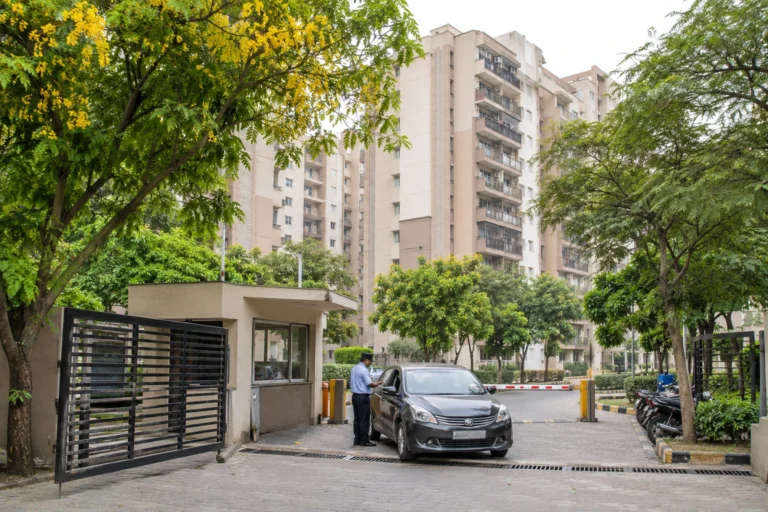

Ready to move vs under construction in Gurugram: a plain comparison from Mayfair Properties & Developers, as at October 2026. Prices and rents are asking figures from published research and our own listings. General buyer guidance, not advice.
Most weeks somebody sits across the desk at our Sector 48 office with the same dilemma, ready to move vs under construction in Gurugram. There is a finished floor they can walk into next month, and there is a new launch two sectors away that looks cheaper on paper and will be ready “in three years”. Which one is the better buy.
We have been selling and letting homes in Gurugram since 1999, and the honest answer is that we have seen both choices work out well and both go wrong.
So rather than push you one way, this guide puts the two options side by side on the things that actually decide it: what you pay and when, what GST does to the sum, what it costs to wait, what the delay record in this city looks like, what the regulator does and does not do for you, and how the tax rules that changed in April 2026 treat each option. There is a worked example on a Rs 2.20 crore budget near the end so you can see real numbers.
A note before we start. Everything here is as at October 2026 and is general information, not advice for your situation. Prices quoted are asking prices from published research, not registered transaction values. Tax and legal points change by notification, so please run your own numbers past a chartered accountant and a lawyer before you commit. We sell homes; we do not practise tax or law.
What the two terms actually mean
Ready to move means the building has its occupation certificate (OC) from the authority, the seller can execute a conveyance deed in your name now, and you can register and shift in. It can be a brand-new unit from a developer, a fresh builder floor from a plot owner, or a resale.
Under construction means you are buying a unit that does not physically exist yet, or is partly built, and you pay the developer in instalments linked to construction stages. A new launch is the earliest version of this: bookings open when the site is still a hoarding.
There is a useful middle category people forget: near-ready, where the structure is up, finishing is on, and OC is perhaps six to twelve months away. Much of what follows applies to it in diluted form, and for many buyers it turns out to be the sensible compromise.
Ready to move vs under construction in Gurugram: the money, side by side
Here is the comparison most people are really asking for. Figures are for a non-affordable home, which in Gurugram today means almost everything.

| Item | Ready to move | Under construction |
|---|---|---|
| Base price | Higher, you pay for certainty | Lower, typically quoted 10 to 20 percent below comparable ready stock (market rule of thumb, varies by project) |
| GST | Nil, once OC is issued | 5 percent of the agreement value, no credit, charged on every instalment paid before OC |
| Stamp duty and registration | 7 percent in urban Gurugram (5 percent for a woman buyer) plus registration fee up to Rs 50,000, paid at purchase | Same rates, but paid later, when the developer executes the conveyance deed after OC, on the collector rate applicable that day |
| TDS | 1 percent if price is Rs 50 lakh or more, deducted at payment | Same, deducted on each instalment |
| Rent while you wait | None, you move in | Full rent until possession |
| Loan interest before you get keys | You pay EMI from day one, but you are living in the home | Pre-EMI interest on whatever the bank has disbursed, while you also pay rent |
| Maintenance and property tax | From day one | From possession, though some builders collect advance maintenance at handover |
| Tax deduction on home-loan interest | From the first year | Pre-construction interest accumulates and is allowed in five instalments after completion (see the tax section) |
| Rental income, if you let it out | From month one | Nothing until OC |
The two lines that catch people out are GST and rent. On a Rs 2 crore agreement, GST alone is Rs 10 lakh. Three years of rent in a decent Sohna Road or Golf Course Extension society is another Rs 20 lakh or more. Both are money that buys you no asset. We go through this properly in the worked example.
For the full registration process and the 2026 TDS form, see our guide to property registration charges in Gurugram.
How big is the price gap, really
Two things we can say with data. First, Gurugram’s average quoted price rose from around Rs 6,150 per sq ft in 2019 to Rs 13,350 by the June 2026 quarter, according to ANAROCK, with Dwarka Expressway at roughly Rs 14,180 and New Gurugram at Rs 13,450 in the June 2026 quarter.
Second, new launches in 2026 are priced for the top of the market: ANAROCK’s data for the April to June quarter shows 26 percent of new NCR units launched above Rs 4 crore and another 19 percent between Rs 2.5 and 4 crore. The old pattern of a launch priced well below the finished building next door is less common on Golf Course Extension Road and Southern Peripheral Road than it was in 2021. It still exists in New Gurugram, on the Dwarka Expressway sectors, and towards Sohna.
The cost of waiting, which nobody puts in the brochure
Three costs sit on the under-construction side and are routinely left out of the conversation.
- GST at 5 percent. This is the rate for under-construction residential property since April 2019, and the GST 2.0 changes of September 2025 did not touch it. (They cut GST on cement from 28 to 18 percent, which helps the builder’s cost, not your invoice.) A ready home with OC, or a resale, carries no GST at all. On Rs 1.90 crore, the difference is Rs 9.5 lakh. (The 5 percent is the effective rate on the full agreement value, after the deemed one-third deduction for land; some online calculators wrongly show 3.33 percent.)
- Rent. If you live on rent today, every month of construction is a month of rent. Three years at Rs 60,000 is Rs 21.6 lakh. Each year of delay adds another Rs 7 lakh or so.
- Pre-EMI interest. Under a construction-linked plan the bank disburses in stages and charges you interest on what it has released, while you pay rent at the same time. It is interest that buys you no equity, and it grows as the project nears completion because more of the loan is drawn. The ready buyer is paying EMI interest in the same period, of course, so the fair comparison is the gap between the two, which the worked example below shows.
Set against these, the under-construction buyer has three genuine advantages: a lower base price, a newer building with a fresh five-year defect liability, and the chance that the market moves up between booking and possession, in which case the gain is earned on the lower base. Whether those outweigh the carrying costs depends almost entirely on whether the project finishes on time. Which brings us to the uncomfortable part.
Delay: what the Gurugram record actually shows
We want to be careful here, because official delay statistics for Gurugram are thin and the loudest numbers online are not from the regulator.
What we can point to:
- A June 2026 review by PropReport, a private data firm, of Gurugram projects launched between 2015 and 2021 found a median handover about two and a half years after the committed date, with fewer than one in five delivered on time. That is one firm’s estimate from its own tracking, not a government figure. We cite it because nothing better exists.
- On 11 August 2026, HRERA Gurugram, the state real estate regulator, gave a blanket four-month extension to every project registered on or before 31 July 2026 whose completion date fell on or after 28 February 2026, citing supply disruption from the West Asia conflict. The practical point for you: if the project you are looking at was registered before August 2026, its committed date has already moved four months by order, before a single site-specific delay. A launch registered after that date does not carry the extension.
- The extreme case is still unfolding. Buyers in Greenopolis, Sector 89, roughly 1,300 to 1,650 families who paid around Rs 1,159 crore, have waited eleven years and in October 2026 are still in court. It is not typical. It is what the tail of the distribution looks like.
- Orders are not money. In September 2026 the Gurugram administration began a recovery drive for Rs 446 crore of regulator-ordered refunds and interest owed by 71 developers, some of it pending for over four years.
None of this means you should never buy under construction. It means the date in the brochure is a plan, and you should buy only if your finances survive the plan slipping by a year or two.
What the regulator gives you, and what it does not
The Real Estate (Regulation and Development) Act 2016 and the Haryana rules under it are the reason buying under construction is safer than it was ten years ago. The protections that matter:
- Registration and public disclosure. Every project above a small threshold must be registered with HRERA Gurugram before it can be sold, with the sanctioned plan, the committed completion date and quarterly progress updates on the regulator’s website. You can read all of this yourself before you pay a token.
- The 70 percent account. Seventy percent of what buyers pay must go into a separate project account and can only be drawn against certified construction progress. This is what stops your money building a different project.
- Your choice on delay. If the developer misses the committed date, Section 18 lets you either withdraw with a full refund plus interest, or stay in and receive interest for every month of delay. The Supreme Court confirmed in Newtech Promoters (2021) and again in Experion Developers (2022) that this choice is yours, not the developer’s.
- The interest rate. In Haryana it is the State Bank of India’s highest marginal cost of lending rate plus 2 percent. Orders passed in August and September 2026 used 10.80 percent a year. Check the current SBI rate on the day; it moves.
- Five-year defect liability. Structural or workmanship defects reported within five years of possession must be fixed within 30 days at the developer’s cost.
- Pre-possession charges. The regulator has struck down advance maintenance and similar demands made before handover; a July 2026 order on BPTP Park Spacio, Sector 37D, directed a refund with 11 percent interest.
What it does not do: it does not build the project for you, it does not pay you until you file a complaint and win, and as the Rs 446 crore recovery drive shows, winning and being paid are two different events. It also does not vet the developer’s finances in any depth. Registration is a disclosure requirement, not an endorsement.
How to check an under-construction project before you book
Ten minutes on the regulator’s website and one honest conversation will tell you more than any brochure.
- Find the project on the HRERA Gurugram portal. Note the registration number, the committed completion date (if the project was registered on or before 31 July 2026, add the four-month extension granted in August 2026), the number of quarterly progress reports actually filed, and any complaints or orders listed against the project or the promoter.
- Check the DTCP licence for the land under the project and that the sanctioned plan matches what you are being sold, including the floor you are being offered.
- Ask for the developer’s last three deliveries by name and go and look at one. Ask residents when they were promised possession and when they got it. This single step would have saved most of the buyers we have met who regret a purchase.
- Ask who is funding the construction. A project with a lender’s construction finance in place and an escrow account that is actually being used is in a different risk class from one being built out of your instalments alone.
- Read the builder-buyer agreement, specifically the possession clause, the grace period, the per-month compensation if they are late, the per-month penalty if you are late, and the “force majeure” definition. If the penalty on you is 18 percent and the compensation to you is Rs 5 per sq ft, you have learnt something.
- Be careful with “no EMI till possession” schemes. In July 2019 the National Housing Bank told housing finance companies to stop products where the builder pays your pre-EMI, after complaints and fraud. Some banks still fund such plans. The risk is simple: the loan is in your name, and if the builder stops paying, it is your credit record and your EMI.
- Prefer a construction-linked or possession-linked plan over a heavy upfront payment, however attractive the discount for paying early. Your money should go out at the speed the building goes up.
The tax side, after the Income-tax Act 2025
This is the part most online guides still get wrong, because the law changed on 1 April 2026. The Income-tax Act 2025 replaced the old Act, and the home-loan rules moved to new section numbers. In outline, and please confirm with your CA:
- Interest on a self-occupied home (old regime). Section 22 allows up to Rs 2 lakh a year, but only if the home is completed within five years from the end of the financial year in which you took the loan. If it is not, the cap drops to Rs 30,000. A two-and-a-half-year delay on a three-year project can push you past that line.
- Pre-construction interest. Interest you paid before the year of completion is not lost; section 22(1)(c) lets you claim it in five equal instalments starting from the year the home is completed, within the same overall cap. So an under-construction buyer gets the deduction late and squeezed; a ready buyer claims from year one.
- New regime. There is no interest deduction on a self-occupied home under the new default regime. If you are in the new regime, the tax argument for either option largely disappears for self-use. For a let-out property, interest remains deductible against the rent in both regimes, with the Rs 2 lakh house-property loss set-off against other income limited to the old regime.
- Principal. Repayment of principal, and stamp duty paid in the year, count towards the Rs 1.5 lakh limit under section 123 in the old regime, with a clawback if you sell within five years.
Nothing here should decide the purchase on its own. It is one more cost of waiting that sits on the under-construction side.
Rental income and appreciation: facts, then opinion
Facts. A ready home earns rent from the first month; an under-construction home earns nothing until OC. ANAROCK puts Gurugram’s gross rental yield at about 4.3 percent in mid-2026, up from 3.5 percent in 2019. Corridor-level readings from Square Yards are lower, between 2.2 and 2.7 percent, because they divide one quoted rent by one quoted price. The two are measured differently and nobody has reconciled them, so for planning we use 2.5 to 4 percent and would not promise anyone more.
Our own rent listings on Sohna Road and Golf Course Extension Road sit at roughly Rs 60,000 to 75,000 a month for a 3 or 4 BHK, which is the figure we use in the example below.
On appreciation, the record is strong and recent: Gurugram’s average asking price more than doubled between 2019 and mid-2026 (ANAROCK: Rs 6,150 to Rs 13,350 per sq ft), and Dwarka Expressway rose faster still, from about Rs 6,000 per sq ft in 2021 to over Rs 14,000 as the road opened. But the latest quarters are softer. Knight Frank’s nine-month 2026 data has Gurugram’s weighted average price up just 4 percent and the city holding 57 percent of NCR’s unsold stock; ANAROCK’s September quarter shows NCR sales down 1 percent on the year with launches down 14 percent.
Opinion, clearly labelled. The 2022 to 2025 pattern, where booking at launch and holding to possession produced large gains almost everywhere, is less likely to repeat in the established corridors, because 2026 launch prices already sit close to ready prices there. Where the gap is still wide, in parts of New Gurugram, the Dwarka Expressway sectors and towards Sohna, the appreciation case for under-construction remains, and so does the delivery risk. That is not a coincidence.
What buyers are actually choosing in 2026
Two credible surveys came out within days of each other in September 2026 and said opposite things. ANAROCK’s survey of 8,320 buyers found 34 percent preferred a new launch against 18 percent for ready-to-move, a reversal of the 2022 position. Colliers’ survey of about 1,800 buyers found 61 percent preferred ready (31 percent) or near-completion (30 percent) homes, against 20 percent for under-construction and 19 percent for new launches.
Different samples, different questions, different answers. Look closer and they overlap more than the headlines suggest. In both, a clear majority wants a home that is finished or due within a year: 66 percent in ANAROCK’s survey (18 percent ready, 22 percent within six months, 26 percent within a year) and 61 percent in Colliers’. The difference is at the edges: ANAROCK’s new-launch group has grown to 34 percent while its within-six-months group has shrunk from 32 to 22 percent since late 2024.
What both agree on is more useful: the buyers choosing new launches are choosing big, well-capitalised developers, and developer reputation and delivery record rank with or above price in both surveys. The market has not decided that under-construction is better. It has decided that under-construction from a developer with a delivery record is acceptable, and from anyone else is not.
Who should buy which
Our view on ready to move vs under construction in Gurugram, from the people we actually deal with:
Ready to move suits you if
- you are paying rent today and want it to stop;
- you depend on a home loan and want EMI, deduction and possession to start together;
- you may need to sell or move within five years;
- you are buying for parents or for someone who needs certainty more than upside;
- you want to see the view, the light, the neighbours and the lift before you pay.
Under construction suits you if
- you own or occupy a home already, so there is no rent running against the wait;
- your horizon is seven years or more and your finances survive a two-year slip;
- the developer has delivered three comparable projects on time, and you have checked;
- you can keep payments construction-linked and avoid any builder-paid EMI arrangement;
- the specific project’s discount, after GST, is still meaningful.
Near-ready is the middle path. Six to twelve months from OC, structure complete, a modest discount still available, the worst of the delay risk behind it, and GST still payable but on a shorter instalment run. Colliers’ 2026 survey puts 30 percent of buyers in exactly this camp, and for a lot of first-time buyers in the Rs 1.5 to 2.5 crore band this is where we end up pointing.
A worked example on Rs 2.20 crore
This is an illustration with rounded numbers. Prices are asking prices; the under-construction unit is hypothetical; your loan rate, rent and dates will differ.
Option A, ready. A new 3 BHK builder floor in Ansal Versalia, Sector 67A, about 1,300 sq ft of floor area as listed, fit-out done, immediate possession. Our own listing, priced at Rs 2.20 crore on the second and third floors. GST nil. Stamp duty and registration at purchase: about Rs 15.9 lakh for a male buyer, Rs 11.5 lakh for a woman. You move in next month and stop paying rent.
Option B, under construction. A 3 BHK apartment of similar size in the same corridor, under construction, possession committed in 36 months, agreement value Rs 1.90 crore. That is about 14 percent below Option A, in the middle of the range people quote.
| Over the first three years | Option A, ready | Option B, under construction |
|---|---|---|
| Price | Rs 2.20 crore | Rs 1.90 crore |
| GST | Nil | Rs 9.5 lakh |
| Rent paid while waiting (Rs 60,000 a month) | Nil | Rs 21.6 lakh |
| Loan interest, same Rs 1.4 crore loan at about 8.5 percent | About Rs 35 lakh of EMI interest, paid while living in the home (about Rs 9 lakh of principal repaid alongside) | Roughly Rs 20 lakh of pre-EMI interest on a loan drawn 60 percent on average, paid while also paying rent, no principal repaid |
| Stamp duty and registration | Rs 15.9 lakh now | About Rs 13.8 lakh at conveyance in year three if the agreement value is still above the collector rate; residential collector rates in Sectors 63 to 67 rose 30 to 45 percent in April 2026, so assume similar or higher |
| Money out that buys no asset, three years | About Rs 35 lakh (interest) | About Rs 51 lakh (GST, rent, pre-EMI) |
| Extra cost of waiting, net of what the ready buyer pays anyway | About Rs 16 to 18 lakh | |
| Headline saving on price | Rs 30 lakh | |
| Net position if delivered on time and the finished flat is worth what the ready one is worth then | Option B ahead by roughly Rs 12 to 15 lakh, about 6 percent of the price | |
| The same, 12 months late | Option B ahead by roughly Rs 8 lakh | |
| The same, 30 months late (the median in the PropReport review) | Level | |
| If the discount never closes and the finished flat is simply worth 14 percent less | Option A ahead by roughly Rs 20 lakh on time, more with delay |
Read it plainly. The Rs 30 lakh saved on price buys about Rs 16 to 18 lakh of extra carrying cost: GST, rent and pre-EMI, net of the EMI interest the ready buyer is paying anyway over the same three years. If the project delivers on time and the finished flat is worth what comparable ready homes are worth at possession, the under-construction buyer finishes roughly Rs 12 to 15 lakh ahead, about 6 percent of the price. That is the whole reward for carrying the construction risk.
Each year of delay costs the under-construction buyer about Rs 17 lakh in rent and interest, roughly Rs 6 to 7 lakh more than the ready buyer pays in EMI interest over the same year, so the advantage is gone at around 30 months late, which is the median in the PropReport review, and negative beyond that. That is before the tax cap, the higher collector rate at conveyance, and the tail where the project never arrives.
(Two smaller effects run the other way: the under-construction buyer ties up about Rs 20 lakh less of their own money in the early years, and pays stamp duty on a lower agreement value.) And remember that the delay interest the regulator can award is worth exactly what recovery is worth; Rs 446 crore of such orders were still unpaid in Gurugram in September 2026.
Mistakes we see
- Comparing the under-construction base price with the ready all-in price, and forgetting GST sits on one side only.
- Treating the brochure’s possession date as a date rather than a plan, and signing a lease or a sale on the old home around it.
- Paying 40 or 50 percent upfront for a discount, which shifts all the project risk onto you.
- Taking a builder-paid EMI scheme without reading who is liable when the builder stops.
- Buying a resale under-construction unit on a transfer letter without checking the developer’s transfer charge and whether the original allottee has cleared every instalment, and forgetting that GST still applies to the instalments you pay before OC.
- In a ready purchase, skipping the OC check because “everyone has moved in”. Occupied is not the same as approved.
Questions we get asked
Is GST charged if the project gets OC before I pay the last instalment?
GST applies to instalments paid before the OC is issued. Payments made after OC are outside GST. Ask the developer for the OC date in writing and check the instalment schedule against it.
Do I pay stamp duty twice on an under-construction flat?
No. Stamp duty is paid once, on the conveyance deed executed after completion. Some developers charge stamp duty on the builder-buyer agreement; that is a small sum and separate from the main deed.
Can I claim home-loan interest while the flat is being built?
Not in that year. Under section 22(1)(c) of the Income-tax Act 2025 the pre-construction interest is allowed in five instalments from the year of completion, within the Rs 2 lakh cap for a self-occupied home in the old regime. Confirm your position with a CA.
What if the developer misses the date?
Under Section 18 you may withdraw with a full refund and interest, or stay and claim interest for each month of delay, currently around 10.8 percent a year in Haryana orders. You will need to file a complaint with the regulator; it is not automatic.
Is a ready builder floor safer than an under-construction apartment?
On delivery risk, yes, because it exists. On everything else, it is a different product with its own trade-offs, which we cover in builder floor vs apartment in Gurugram.
Does "near-ready" carry GST?
Yes, on instalments paid before OC. If OC is three months away and 90 percent is already paid by the previous allottee or by you, the GST exposure on the balance is small.
Ready to move vs under construction in Gurugram: the short version
- Under construction is quoted 10 to 20 percent cheaper, but that is a rule of thumb, not data. Price a specific pair.
- Add 5 percent GST, your rent for the build period, and pre-EMI interest. On a Rs 1.90 crore flat over three years those run to about Rs 50 lakh, roughly Rs 16 to 18 lakh more than the ready buyer’s EMI interest over the same period, and each year of delay adds another Rs 6 to 7 lakh to the gap.
- Gurugram’s delay record is real: one private review puts the median at two and a half years late, and most projects registered before August 2026 already carry a four-month extension by order.
- The regulator gives you disclosure, an escrow rule, a right to refund or interest, and defect liability. It does not give you the home on the date.
- Under the Income-tax Act 2025 an under-construction buyer gets the interest deduction late, and loses most of it if completion slips past five years.
- Ready suits renters, loan-dependent buyers and anyone with a short horizon. Under construction suits those with no rent running, a long horizon, and a developer with a verified record. Near-ready is often the answer.
If you tell us your budget and the date you actually need to move, we can tell you honestly whether ready or near-ready stock exists in that band on Sohna Road, Golf Course Extension Road, Southern Peripheral Road or New Gurugram, and where the under-construction discount is still real. See our current listings or write to us.
This article is general information as at October 2026 and not legal, tax or investment advice. Prices and rents are quoted figures from published research and our own listings, not registered values. Please seek professional advice before making any purchase decision.