
Every week someone forwards us the same kind of WhatsApp message. A new launch in Gurugram, a rate per square foot that looks lower than anything on the resale market, an EOI amount, and a line saying the window closes on Sunday. The person forwarding it usually has one question: is this real?
Sometimes it is. Gurugram recorded more residential launch value than any other city in the country in PropEquity’s count for 2025, about Rs 1.38 lakh crore across roughly 23,800 homes at an average above Rs 6 crore a unit, and a good share of that sits on the corridors we work on every day, Sohna Road, Southern Peripheral Road and Golf Course Extension Road.
But a launch is a product with its own rules, prices and risks, and most of what reaches a buyer’s phone leaves those out. This note explains how a new launch in Gurugram actually works in 2026, how to read the price list, what a channel partner like us does and does not do, and the questions to ask before any money leaves your account. It is not a list of projects with prices. Those change every few weeks, so we share them on request, with the date printed on them.
The short version
- A new launch is a home that will be ready in four to six years. It is priced below a ready home in the same sector because you are taking on time and construction risk, not because somebody is doing you a favour.
- Nothing should be paid before the project is registered with Haryana’s real estate regulator. Advertising, booking or collecting money before registration is illegal for the developer, and the regulator has fined well-known developers for it, Rs 50 lakh to Rs 2.5 crore a project in cases from 2021 to 2025. In August 2026 it publicly told buyers not to book or pay in unregistered projects either.
- Booking money plus any EOI should not cross 10 per cent of the price before a registered agreement for sale. That is the law, not a negotiation.
- The rate per square foot is quoted on super area. Add preferential location charges, parking, club, interest-free maintenance security, 5 per cent GST and, at possession, stamp duty and registration. On a Rs 4 crore headline the all-in figure lands between roughly Rs 4.6 and 4.7 crore. Our worked example is below.
- The payment plan decides your risk more than the rate does. Construction-linked is the safest. Down-payment and “no EMI till possession” plans put the most money at risk earliest.
- In 2026 launches are running ahead of sales across the National Capital Region in the Rs 2 to 5 crore and Rs 5 to 10 crore brackets. You have time. Nothing genuinely closes on Sunday.
A new launch in Gurugram is a home that will
be ready
The word gets used for everything from a land purchase announcement to a tower that is already ten floors up. The real sequence looks like this.
Land and licence. The developer buys or ties up land and applies to the Haryana Town and Country Planning department for a group housing licence. Without this licence there is no project, only a plot.
Approvals. Building plans, environment clearance for large projects, fire scheme, water and sewerage assurances. Some of these arrive before launch, some after. The regulator’s project page lists what is obtained and what is still in process, and that list is worth reading.
Registration with the regulator. The law requires the project to be registered before it is advertised or sold. The certificate carries the promoter’s committed completion date. This is the single document that turns a rumour into a product.
Launch. A price list is published, units are allotted, booking money is taken and an agreement for sale follows. From here payments move with construction.
Construction and possession. Large towers in Gurugram take four to six years from launch to keys. Possession happens after the occupation certificate, and the conveyance deed is registered at the Tehsil at that stage, which is when stamp duty is paid. Our guide to registration charges in Gurugram covers that bill.
Everything that happens before registration, and in practice a lot does, is the risky part. That is the next section.
Pre-launch, EOI and launch: three prices, three risks
Pre-launch. The developer has land and usually a licence, but no registration yet. Brokers and sometimes the developer’s own team collect an expression of interest, an EOI, from buyers who want first pick. In premium Gurugram projects this is typically a cheque or transfer of Rs 5 to 25 lakh, taken as a refundable, interest-free deposit, against a rate that is said to be lower than the launch rate. The law does not allow the developer to advertise, book or sell at this stage, and on 14 August 2026 the Haryana regulator publicly told buyers not to book or pay in unregistered projects and told developers to stop pre-launch offers.
Our position is simple: we do not ask you for an EOI on a project that is not yet registered, and we suggest you do not pay one to anyone else either. An EOI gives you no right to a unit, and the rate you were quoted is not binding until it is on a published price list.
If you have already paid one, the receipt is your only protection: it should say refundable, without deduction, with a date and a refund period.
Launch. Registration is done, the price list exists, and the developer issues an allotment letter against a booking amount, normally 10 per cent of the price. An allotment letter reserves a specific unit. It is not the agreement. Until the agreement for sale is signed and registered, your rights are limited to what the allotment letter says about refunds and cancellation, so read that page before you pay.
Later inventory. Six to eighteen months after launch the developer releases further towers or floors, usually at a higher rate. This is not automatically a worse deal. You can see the site, the pace of work, which floors are actually available rather than “sold out” on a chart, and whether the developer has kept to its first milestones. Many of our clients do better here than at pre-launch, simply because they are choosing a real floor in a real tower.
The honest summary for any new launch in Gurugram: pre-launch offers a defined product with the law behind it, and later inventory costs more but removes most of the guesswork.
How to read a price list
The price list for a new launch in Gurugram has a headline rate per square foot and then a second page that most buyers do not read. Start with the area the rate is quoted on.
Carpet, built-up, super. Carpet area is the floor you can walk on inside the walls. Built-up adds walls and balconies. Super area adds your share of lobbies, corridors, club and services, and in premium Gurugram towers that loading is commonly 30 to 45 per cent, and more in some. The rate is quoted on super area. The agreement for sale must state carpet area. A Rs 20,000 rate on super area is roughly Rs 26,000 to 29,000 on carpet, which is the number to compare across projects.
What sits on top of the base rate. Preferential location charges for floor, view or corner units. Car parking, usually one or two slots at a fixed price each. Club membership. External and internal development charges, called EDC and IDC, which are government levies that the developer collects; in many Gurugram premium lists they are built into the base rate, in others they are separate, so ask which. Interest-free maintenance security, called IFMS, which is a deposit held for the society’s future.
GST at 5 per cent on under-construction homes, with no input credit, which has been the rate since April 2019. And at possession, stamp duty of 7 per cent for men, 5 per cent for women and 6 per cent for a joint registration in urban Gurugram, charged on the agreement value or the circle-rate value if that is higher, plus a registration fee capped at Rs 50,000.
Here is a 2,000 sq ft super area unit at a Rs 20,000 rate, with indicative extras. The real list governs; this shows the shape of the bill.
| Item | Basis | Amount |
|---|---|---|
| Base price | 2,000 sq ft x Rs 20,000 | Rs 4,00,00,000 |
| Preferential location charge | indicative Rs 300 per sq ft | Rs 6,00,000 |
| Car parking | one covered slot, indicative | Rs 7,50,000 |
| Club membership | indicative | Rs 3,50,000 |
| EDC and IDC | included in base here; separate in some lists | included |
| Agreement value | sum of the above | Rs 4,17,00,000 |
| GST at 5 per cent | on agreement value | about Rs 20,85,000 |
| IFMS | indicative Rs 150 per sq ft, deposit | Rs 3,00,000 |
| Payable to developer | before registration | about Rs 4,40,85,000 |
| Stamp duty at possession | 5 to 7 per cent of agreement value | Rs 20,85,000 to 29,19,000 |
| Registration fee | capped | Rs 50,000 |
| All-in | roughly 15 to 18 per cent above the headline | about Rs 4.62 to 4.71 crore |
Two habits save money here. Ask for the price list with a date and the developer’s stamp, not a WhatsApp screenshot. And ask, line by line, what the base rate includes, because the gap between two projects is often in the second page, not the headline.
Payment plans, and what each one does to your risk
Construction-linked plan. About 10 per cent at booking, then 5 to 10 per cent at each milestone such as excavation, plinth and every few slabs, and the last 5 to 10 per cent at possession. Your money follows the building. If work slows, your payments slow. A home loan is disbursed in the same stages, so pre-EMI interest starts small and grows. The rate is usually the highest of the plans on offer, and in our view it is worth it.
Milestone plans with fewer, larger instalments. Some launches use a handful of large instalments, for example 20 per cent down and then slices at fixed milestones, or four or five equal parts. Simpler to follow, but check whether each instalment is tied to a construction stage or to a calendar date. Date-based instalments mean you pay on time even if the site does not move.
Down-payment plans. 10:80:10 or 10:90 style, where most of the price is paid within weeks of booking in exchange for a lower rate. You are funding the whole building before it exists. The discount is real, and so is the exposure if the project stalls. We do not recommend this for a first new-launch purchase.
Subvention, or “no EMI till possession”. The loan is in your name from day one. The developer pays the bank’s interest until a fixed date. If the developer stops paying, the bank comes to you, and the default sits on your credit record, not the developer’s. In July 2019 the housing finance regulator told housing finance companies to stop funding these schemes after complaints and reported frauds, and the banking regulator had warned banks off upfront disbursals years earlier. Few mainstream lenders touch them now, so ask hard questions if one appears.
On loans generally: get the project checked by your bank before paying beyond the booking amount. Banks approve projects for lending after a title and approvals check. It is not a certificate of quality, but a project that two or three major banks will not lend on is telling you something.
What a channel partner does, honestly
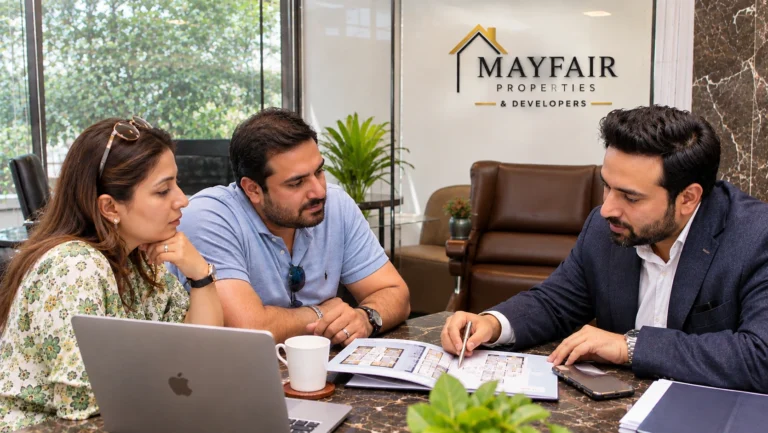
Mayfair Properties & Developers is empanelled as a channel partner with developers including Godrej Properties and M3M for their Gurugram projects. Here is what that means for you, plainly.
The price is the developer’s price. For a booking in any new launch in Gurugram you pay the developer’s price list, the same as at the developer’s own sales desk, with the same date on it. Mayfair is paid by the developer, not by you.
What we add. We work across projects, so you get a comparison, not a single sales pitch. We can usually tell you which towers and floors are genuinely available rather than reading a chart that says sold out. We put two or three site visits into one afternoon. And after booking we chase the allotment letter, the agreement for sale, demand letters and the bank, which is where most of the delays and arguments actually happen.
What we cannot do. We cannot change the developer’s terms, payment plan or possession date. We cannot promise you that the price will rise; nobody can, and on Golf Course Extension Road average rates moved only about 0.4 per cent year on year to September 2026 even as launches continued. We cannot speed up construction. And if anyone, including us, says there is an extra discount available only through them, ask for it on the developer’s letterhead. If it is not there, it does not exist.
What is on the table right now
As of early November 2026 we are taking clients to Godrej and M3M projects on Golf Course Extension Road, Southern Peripheral Road and Sohna Road, across roughly Rs 2.5 crore to Rs 12 crore. We do not reproduce developer price lists on this page. They change, and the developer, not the channel partner, decides what is published. Message us and we will send the current lists with their dates, along with what is actually available in each tower.
One rule we keep for this page and for our WhatsApp replies: we only discuss projects whose registration certificate has been issued. If a project is still at the pre-launch or EOI stage, we will tell you that it is, and we will not quote a price for it.
Twelve checks before you pay anything
- Registration first. Find the project on the Haryana regulator’s website: promoter name, committed completion date, approvals obtained. If it is not there, no money, however small the amount.
- Licence and land. Ask for the Town and Country Planning licence number and the land ownership or collaboration agreement. The regulator page usually links both.
- Approvals obtained versus in process. Building plans and environment clearance should be obtained before you pay. Fire, electrical and service plan approvals often follow; know which is which.
- The 10 per cent rule. EOI plus booking must not cross 10 per cent of the price before a registered agreement for sale. If a plan asks for more earlier, that is a red flag by itself.
- Read the agreement before the EOI, not after. Carpet area, possession date, interest on delay payable by both sides, what charges can change later, and what is forfeited on cancellation.
- A dated, stamped price list. With a line that says what the base rate includes. Screenshots are not price lists.
- The payment plan. Construction-linked or date-linked, and how much sits with the developer before the first slab is poured.
- Bank approval. At least two major banks lending on the project, and your own sanction letter before you pay beyond booking.
- The developer’s record in Gurugram. Which projects, promised date versus actual possession, and the complaints list on the regulator’s site. Big names have delays too; what you want is the pattern.
- The project account. By law 70 per cent of what buyers pay goes into a separate account used only for that project’s land and construction. Ask which bank holds it.
- Life after possession. Estimated monthly maintenance, how IFMS is held, and who runs the society for the first years. Our gated society checklist covers what to ask.
- Your exit. Selling before possession usually needs the developer’s consent, a transfer fee and sometimes a lock-in period. GST paid is not refunded on resale. Know the numbers before you need them.
New launch, ready to move or resale in 2026
We wrote a full comparison of ready to move versus under construction in Gurugram. The short form, for a launch specifically:
| New launch | Ready or resale | |
|---|---|---|
| Rate per sq ft | Lower than ready stock in the same sector, usually by a meaningful margin | Higher, but what you see is what you get |
| Taxes | 5 per cent GST, plus stamp duty at possession | No GST; stamp duty at registration |
| Money out | Staged over four to six years | Nearly all at once |
| Choice | Floor, tower and sometimes layout | Whatever is on the market this month |
| Waiting | Typically four to six years, plus rent meanwhile | Keys in two to three months |
| Risk | Delay, specification drift, rate not rising as hoped | Age of building, pending dues, seller’s paperwork |
| Exit before keys | Needs developer consent and a transfer fee | Sell whenever you like |
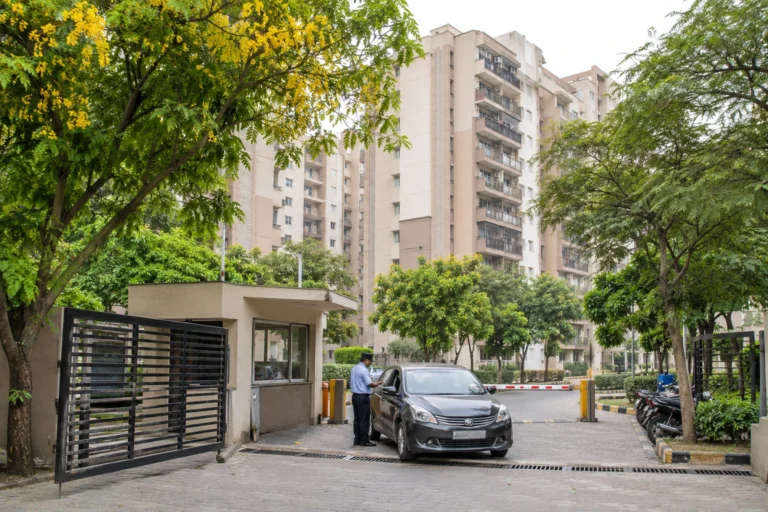
Who should buy a new launch in Gurugram: a buyer who already has a roof, can carry the staged payments without stretching, and wants a specific floor in a specific corridor. Who should not: a family that needs to move within two years, anyone relying on the flat rising in value to make the maths work, and anyone whose entire down payment is the EOI. Our Gurugram property prices 2026 note has the corridor rates if you want to check a launch quote against ready stock nearby.
Where the market stands, and what it means for you
Three dated numbers worth having. Knight Frank’s count for January to September 2026 shows housing sales in the National Capital Region down about 11 per cent, led by Gurugram, while developers launched 17,273 homes in the Rs 2 to 5 crore bracket against 15,333 sold, and in the Rs 5 to 10 crore bracket the July to September quarter saw 2,346 launches against 925 sales.
Anarock’s third-quarter 2026 report puts new supply in the region 14 per cent lower than a year earlier, which suggests developers have noticed. And Square Yards data to September 2026 has Golf Course Extension Road at roughly Rs 19,100 to 19,300 per sq ft, almost flat year on year, while Knight Frank’s broader Gurugram index is up about 4 per cent over the year. Flat to slow, not falling.
For a buyer looking at a new launch in Gurugram this adds up to one thing: leverage. In the Rs 2 to 5 crore and Rs 5 to 10 crore brackets launches outnumber sales, and there the developer needs you more than the message on your phone suggests. Negotiate on the parts of the list that move, parking, club, preferential location charges and the payment plan, rather than the base rate, which rarely does. And take the week you need to do the twelve checks above.
Frequently asked questions
Is the price higher if I buy through a channel partner?
No. The channel partner sells from the developer’s price list at the developer’s price. If anyone quotes you a different rate for the same unit on the same day, one of the two numbers is wrong, and you should ask the developer’s office directly.Can I get my EOI back if I change my mind?
Better not to be in that position: the regulator told buyers in August 2026 not to pay anything in a project that is not registered, and we do not ask for EOIs on unregistered projects. If you have already paid one, the terms are whatever the receipt says, so check it for the refund period and the words “without deduction”. After allotment and booking, cancellation terms in the allotment letter apply and a forfeiture is common.When is GST payable on a new launch in Gurugram?
GST at 5 per cent applies to every instalment paid while the building is under construction, with no input credit. It is not payable on a home bought after the occupation or completion certificate is issued, or first occupation if earlier, and it is not payable on resale. Stamp duty is separate and is paid at registration of the conveyance deed at possession.Can an NRI book in a new launch in Gurugram?
Yes. An NRI or OCI can buy residential property in Gurugram without any approval, paying from an NRE, NRO or FCNR account or by inward remittance. A power of attorney holder in India can sign on their behalf. Our note on buying property in Gurugram as an NRI goes through the money, tax and PoA steps.How long before the flat is registered in my name?
The agreement for sale should be signed and registered within weeks of booking, and you should insist on it; that is the document that protects your payments. The conveyance deed, which transfers ownership, is registered at possession, four to six years later for a tower, and that is when stamp duty and the registration fee are paid.Is the pre-launch rate of a new launch in Gurugram really lower?
Often it is, by a few per cent against the launch list. The question is what you are giving up for it: no registration, no binding price, no allotment, a refund that depends on the receipt, and a regulator that has told buyers not to pay before registration. For most first-time buyers the launch list, or even later inventory where you can see the tower, is the better trade.Before you reply to that message
A new launch in Gurugram can be a good purchase. The buyers who do well are the ones who treat it as a four-to-six-year financial commitment with a building at the end of it, not as an offer that closes on Sunday. Check the registration, read the second page of the price list, choose the payment plan that keeps your money close to the construction, and keep every promise in writing.
If you want the current Godrej and M3M lists for Golf Course Extension Road, Southern Peripheral Road or Sohna Road, message us on WhatsApp at +91 93501 12902. We will send the lists with their dates and tell you what is genuinely available.
This note is general information based on sources dated as mentioned, and it is not legal, tax or investment advice. Prices, approvals and payment plans change; verify every figure against the current price list and the regulator’s record, and seek professional advice before you commit money.
We send them with their dates, and tell you which towers and floors are genuinely available. No pressure, no Sunday deadline.
Office WhatsApp +91 93501 12902 · Wed to Mon, 10 am to 6 pm · Registered projects only; we do not quote prices for pre-launch or EOI-stage projects.